


More links can lift rankings, but raw counts don’t tell the whole story. Search engines read two separate signals: the total number of backlinks and the number of referring domains. Think of it like mentions vs. unique sources. This guide explains both, compares backlinks vs. referring domains, shows where to track them, and shares practical ways to earn more quality websites linking to you.


🔗 Quick Backlink Definition
A backlink is a hyperlink on another site that points to your page. One website linking to you equals one backlink. If that same site also links to a second page on your site, that’s another backlink. Backlinks help crawlers find pages, pass topical hints through anchor text, and signal authority based on the linking page and site.
🖥 Quick Referring Domain Definition
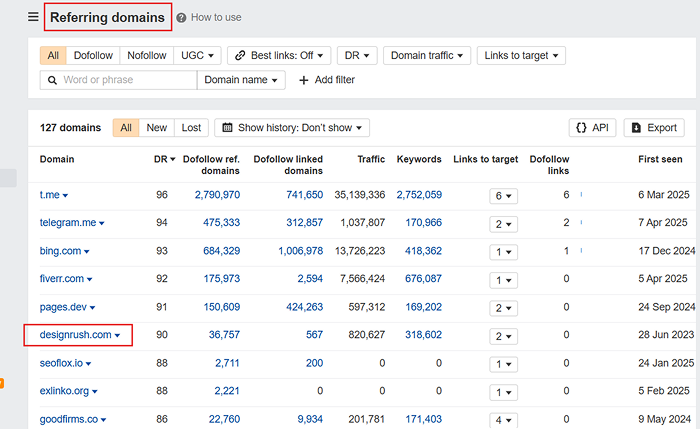
What is a referring domain? It’s a unique website that links to you, no matter how many individual links it sends. If one blog links to five different pages on your site, that’s still one referring domain. Linking sites refer to the count of distinct websites that vouch for you with at least one link.
📊 Backlink vs. Referring Domain: How They Differ and Work Together?
People often ask, referring domains vs. backlinks – which matters more? Both matter, but in different ways.
| Aspect | Backlinks | Referring Domains |
| What it measures | Individual hyperlinks pointing to your pages | Unique websites that link to you |
| How it counts | Each link is one unit | Each website is one unit, no matter how many links it has |
| Example (3 links from one blog) | Counts as 3 | Counts as 1 |
| Main SEO value | Crawling, relevance signals, and depth of coverage across your site | Breadth of trust and recognition across the web |
| Quality emphasis | Page quality, context, and anchor text | Site quality, topical fit, and domain reputation |
| When it helps most | Strengthening specific pages, internal distribution, and deep site sections | Building domain-level authority and resilience |
| Common mistake | Chasing raw volume without context | Ignoring anchor variety and link placement because “the domain already linked once” |
The difference between backlinks and referring domains is simple: use backlinks to power up target pages; grow referring domains to build overall trust and resilience.
➡️ Where to Check Your Numbers Fast?
You don’t need fancy dashboards. Use Ahrefs and Google Search Console to watch the basics: totals, new vs. lost, anchor variety, dofollow vs. nofollow mix, and month-over-month growth in linking sites.
1️⃣ Ahrefs
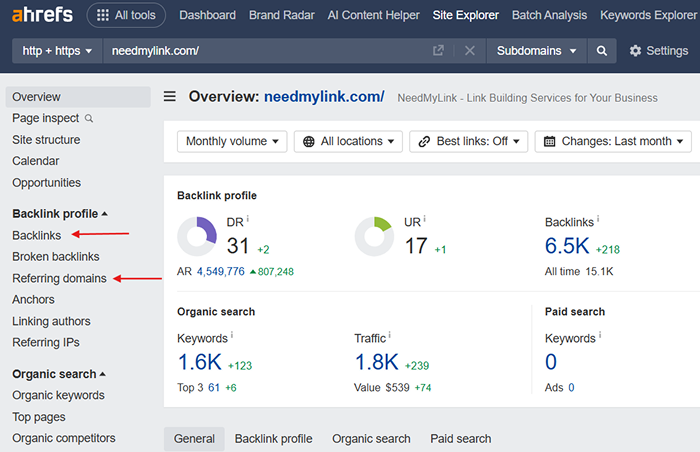
Ahrefs’ Site Explorer gives you a complete snapshot of your link profile – total backlinks, unique referring domains, anchor text usage, linking trends, and the most authoritative pages pointing to your site. In the Backlink Profile tab, the Overview view instantly displays the overall number of links and linking domains. Then:
- The Referring Domains report lets you track which domains were recently gained or lost, their authority scores, when they first and last linked, and which of their pages send the most traffic.
- Check the Anchors tab to find overly repetitive keywords and balance them out with natural phrases – ideally, a mix of branded, descriptive, and topical terms.
- Apply filters for dofollow links to see which backlinks actually transfer authority, then sort them by domain rating or traffic to spot the most impactful ones.
- Keep an eye on the New vs. Lost Links graph. Gradual growth indicates stability, while sudden spikes may reflect PR campaigns or launches. Sharp declines, however, should be investigated quickly.
2️⃣ Google Search Console
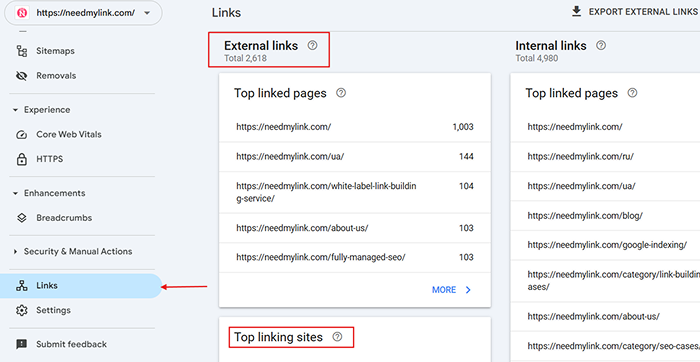
Google Search Console (GSC) is a no-cost platform that reveals how Google itself interprets and records your backlinks. To check backlinks in GSC, open the Links section and look under External links. Two areas matter most:
- The Top linked pages report highlights which URLs attract the most backlinks, helping you confirm whether your high-priority content is gaining traction.
The Top linking sites list shows your referring domains as seen by Google. Exporting it and comparing with Ahrefs can uncover mismatches, trends, or outreach opportunities – for example, a site that linked once may be open to more collaboration.
3️⃣NeedMyLink Backlink Checker
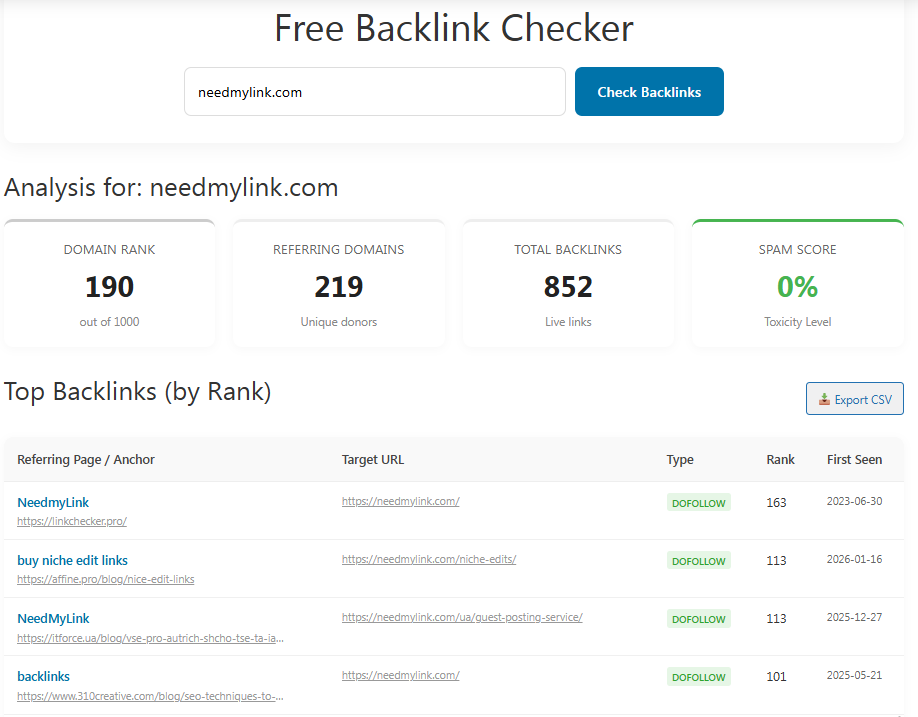
If you need a quick way to check your referring domains, use NeedMyLink Backlink Checker. It shows you which domains link to your website and how many backlinks come from each source.
You can quickly review the total number of referring domains, spot new or lost ones, and evaluate their relevance. This helps you understand whether your link profile is growing steadily and whether the domains linking to you are actually valuable for your niche.
⛔ Mistakes That Hold You Back and Quick Fixes
A healthy link profile is relevant, varied, and consistent. Below are the slip-ups teams make most often, plus quick fixes you can put in place today:
- Chasing volume, ignoring source diversity. Hundreds of links from a handful of sites add noise but little trust.
Fix: Track new referring domains as a core KPI, not just total backlinks.
- Low-quality or off-topic placements. Thin, irrelevant pages send weak signals.
Fix: Aim for contextual links on pages that cover your topic and serve real readers.
- Anchor text tunnel vision. Exact matches repeated too often look forced.
Fix: Keep anchors varied and natural – more branded, URL, and descriptive phrases.
- Sitewide/footer badges only. They add many backlinks but just one referring domain, and usually pass less value than in-content links.
Fix: Prioritize editorial, in-article placements.
- Letting good links decay. Migrations and URL changes quietly break hard-won links.
Fix: Review new/lost trends monthly; reclaim lost links, fix redirects, restore top pages.
Focus on earning links from new, relevant websites, keep anchors natural, and run routine audits to catch issues early. Do that, and your backlink profile will grow in a way that supports real rankings – steadily and safely.
❓ How to Earn More Referring Domains?
If you want targeted help, NeedMyLink can support with digital PR, outreach, and content that naturally earns links. Whether you do it in-house or with a partner, use approaches that create genuine reasons for other sites to reference you. Below are proven plays that work today:
- Publish original data or mini-studies. Survey customers, analyze usage patterns, compile pricing snapshots, or run a small product experiment. Package the story with clear charts and quotable takeaways. Make it easy to cite.
- Build linkable tools and resources. Checklists, calculators, templates, and interactive widgets attract natural citations. Keep them fast, mobile-friendly, and embed-ready. Refresh quarterly and re-pitch.
- Contribute guest pieces with real substance. Pitch outlets that serve your audience, fill a clear gap with step-by-step advice, and include one branded link plus one contextual link that genuinely helps readers.
- Turn company moments into news. Product milestones, research releases, partnerships, scholarships, or community work can spark coverage. Keep a clean media page with bios, logos, and facts so editors can move quickly.
- Curated resource pages (legit ones). Universities, nonprofits, and gov sites maintain high-quality lists. Pitch the most relevant page with a short note on why your resource belongs there.
- Skyscraper refreshes. Find widely linked resources, build a fresher, clearer version (new data, better structure, usable templates), then contact sites that linked to the old one.
- Reclaim unlinked mentions. Set alerts for your brand. When someone mentions you without a link, send a friendly note with the exact URL that helps their readers.
- Partner content. Co-create research, webinars, or toolkits with a brand that serves the same audience; each party has a reason to publish and link.
- Make outreach painless. Every email should answer “Why us, why this, why now?” Keep it short, propose a crisp angle, add a one-line credibility blurb, and include copy-and-paste bullets.
- Maintain variety. As links roll in, keep anchors natural and spread equity across your site’s key hubs so publishers feel good about where they’re sending readers.
When you’re earning more referring domains, you’re proving your value across different corners of the web. Each new, reputable site that links to you acts as another layer of trust in Google’s eyes. By combining those strategies, you can steadily expand your network of unique domains and build a stronger, more resilient SEO foundation.
🏁 Final takeaway
Both metrics matter. Backlinks lift specific pages; referring domains prove that more unique sites find your content worth citing. Aim to add new, relevant linking sites every month while also building the backlinks needed to power your highest-priority pages. Track both in Ahrefs and Google Search Console, keep anchors natural, and keep publishing assets people want to reference. If questions pop up, book a free consultation with NeedMyLink.


