










Keyword research is far from being something only online stores with hundreds of pages need. Almost any website that wants to rank well and generate organic search traffic faces the same challenge. A keyword strategy is never just a single list of phrases: it branches into multiple dimensions, including categories, search intent, and regions.
This is especially relevant for websites that do not have in-house SEO specialists and do not want or cannot afford to hire a separate team. At NeedMyLink, we always tailor keyword research to your specific project!
What Do You Get from a Keyword Research Service?
The same phrase may appear several times in different grammatical forms. A query that looks commercial at first glance may actually produce informational search results, while some keywords in the list may have zero or negligible search volume.
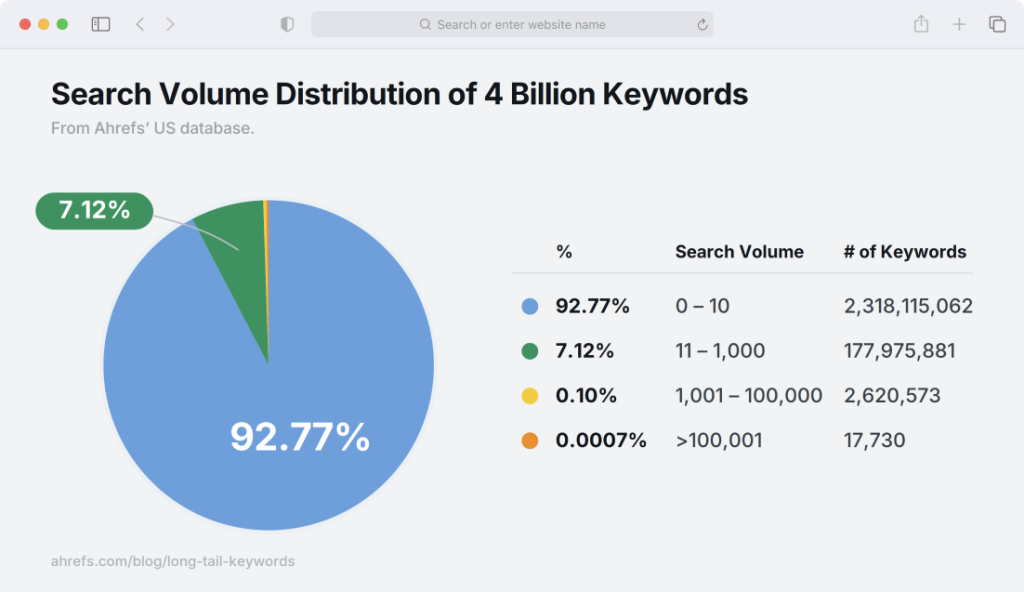
According to Ahrefs, nearly 93% of keywords in its U.S. database receive fewer than ten searches per month, while about 15% of daily Google queries are searches users have never entered before. This does not mean these keywords should be discarded immediately: some are valuable low-volume queries with clear search intent. However, without manual review and keyword grouping, it is impossible to separate useful long-tail keywords from irrelevant queries, and the tool itself does not do this automatically.
Keyword Grouping Based on Search Results
The main method behind keyword research is checking which pages Google actually shows in the top results for each query. If the same pages appear for two different keyword variations, the queries belong to the same keyword group and should generally point to a single landing page. If the search results differ even though the phrases look similar, the search engine recognizes a different intent behind each one. In that case, assigning the queries to separate pages is safer than trying to cover both with a single piece of content.
One sentence with a specific example of two phrases that look similar at first but actually lead to different pages because of different user intent. For example, “buy X” and “X price” may both appear to be commercial queries, but one may lead to a product catalog while the other leads to a pricing or comparison page. A specific example like this makes the section on keyword grouping more practical and easier to understand, instead of leaving it entirely at the level of terminology.
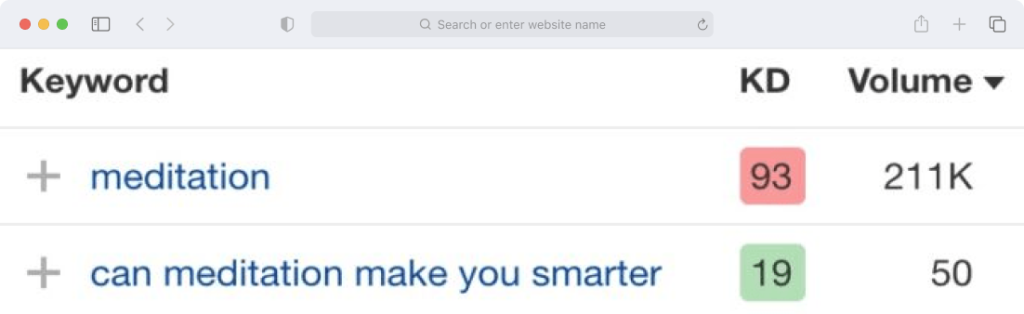
The same principle applies to different markets and languages. A phrase that looks identical may produce different search results and face different levels of competition depending on the region. For this reason, keyword grouping is performed separately for each market rather than transferring the structure of one project directly to another. The research process also identifies related low-volume queries that may not be obvious at first but can expand the keyword strategy and create additional entry points to the website.
The technical side of a website can undermine even perfectly executed keyword research. A recent Need for SEO digest covered a case in which Google indexed private links to Claude chats because they had not been properly blocked from search crawlers. A noindex tag had been placed on a page that the crawler could not even access because it was blocked by robots.txt. It is a classic technical mistake that can make even the most accurate keyword strategy irrelevant.
What a Single Category Can Contain
For a small ten-page brochure website, a hundred keywords may be enough for the entire project. A catalog with several brands is a different story: what appears to be a single category in the website menu may break down into several separate areas during keyword research: brand pages, pages for specific flavors or product variations, and pages for individual product types. Each area requires separate keyword research for every language or market.
A direct translation of a phrase rarely reflects how users actually search for a product in a new market. A different word form or part of speech may be more common, or an entirely different term may become the standard way to describe the same product. As a result, what initially appears to be a single category can turn into several thousand keyword phrases once the analysis is complete, with that number multiplied by the number of countries or languages included in the project.
When Should You Order Keyword Research?
Clients typically need keyword research in several common situations:
- There is no keyword research at all. A new website, landing page, or catalog is launched without any keyword research or strategy in place, making it unclear which pages and queries should form the structure from the ground up.
- New market or language. A direct translation of an existing keyword strategy rarely reflects how users search in a new market. Different grammatical forms may be more common, and users may use different terms for the same product or service.
- Research was done without keyword grouping. There may already be a list containing several thousand keyword phrases in a spreadsheet, but it is unclear which queries should be combined on one page and which should be separated. Without this step, the keyword list remains a reference file rather than a practical working tool.
- A large SEO project is being prepared. Before creating a content plan, launching a comprehensive SEO campaign, or carrying out a large-scale website update, keyword research provides the foundation needed to make informed decisions instead of proceeding largely at random.
- A large-scale project has thousands of pages. A marketplace or large catalog needs more than a keyword list. Keywords must be mapped to the website structure at the individual page level; otherwise, the keyword strategy and site architecture develop independently of each other.
The need for new or updated keyword research can also arise in less obvious situations. For example, the company’s product range or business focus may have changed while the old keyword strategy continues to describe a version of the company that no longer exists. This is common after a rebrand or a change in positioning.
In other cases, the existing keyword strategy may still be relevant, but it is unclear which queries are dominated by strong competitors and where competition is low enough for the website to rank more quickly. Without this information, it is difficult to set the right SEO priorities.
Some industries require particular attention because of their specific rules and limitations for collecting and validating keywords. Examples include iGaming and pharmaceuticals, where not every team is prepared to handle keyword research. In addition, when new brands, categories, or product lines are added to a catalog, an older keyword strategy built around a smaller product range may no longer cover the new products and needs to be expanded.
In practice, these reasons often overlap. For example, a company may enter a new market while simultaneously expanding its product range, allowing one keyword research cycle to address both needs. If the keyword strategy is already in good shape but the website still receives no traffic, possibly because of technical issues, it makes sense to run an SEO audit first and check whether search crawlers can properly access the relevant pages.
Why Do We Use P1-P3 Priority Labels?
When keyword research produces thousands of phrases organized into dozens of keyword groups, it can be difficult to determine where implementation should begin. This is why each group is assigned a priority level. Without these labels, a client is just as likely to start with a page that could generate traffic within a month as with one that may produce no results even after a year.
The logic is straightforward. P1 includes keyword groups with genuine search demand and relatively low competition for top positions. These are usually the opportunities where results can be achieved fastest. P2 includes groups that strengthen existing pages or fill gaps around stronger topics. P3 covers informational or supporting queries that should eventually be addressed but do not require immediate implementation.
In our case, we use color coding along with the main quantitative metrics: volume, difficulty, and global volume. Specialists create a separate worksheet in the spreadsheet for every page and language.
Where Does the Completed Keyword Research Go?
There are several options. The client can map the keywords to individual pages and pass them to their own team, or the keyword research can be handed over to a contractor responsible for content production. If the client continues working with NeedMyLink, the keyword groups with established priorities become the foundation for a content plan. This leaves only one step between completed keyword research and publishing the first pages, without the need for another round of keyword research.
The final research deliverable is a cleaned keyword list with actual search volume, global search volume, and a difficulty score for every phrase, with duplicates and irrelevant noise removed. The queries are then organized into keyword groups based on search engine results pages (SERPs). In the Standard package and above, each keyword group is immediately mapped to a specific website page, either an existing page or one that should be created. Premium and Advanced packages also include P1-P3 priority levels, showing which pages and keyword groups should be addressed first.

Nik Zakharchenko, CBDO of NeedMyLink