


If you want your link building to actually move rankings, you need to track the right signals – not every number on a dashboard is meaningful. The ten best metrics for link building SEO below help you make better decisions in three common scenarios: analyzing your own site’s progress, evaluating a potential donor site before you pitch, and reviewing a competitor to find gaps and opportunities. They’re useful for pure link building and for your broader SEO strategy because they point to quality, relevance, risk, and volume.
A quick note: no single link building metric is a silver bullet. Think in combinations and patterns. A medium-authority, highly relevant page with strong organic traffic can beat a high-authority but off-topic placement. Likewise, a clean anchor on a page where your brand fits will usually outperform a “perfect” metric that lives in a weak or spammy context. Use these metrics as lenses, and you’ll build links that compound value over time.
1️⃣ Domain Strength
Domain-level strength gives you a fast way to size up a site’s overall ability to pass value. The three most common indicators are Moz’s Domain Authority (DA), Ahrefs’ Domain Rating (DR), and Semrush’s Authority Score. None of these are used by Google directly, but they do capture different views of link equity – how many domains link to the site, how strong those domains are, and how the site sits in the broader web graph.
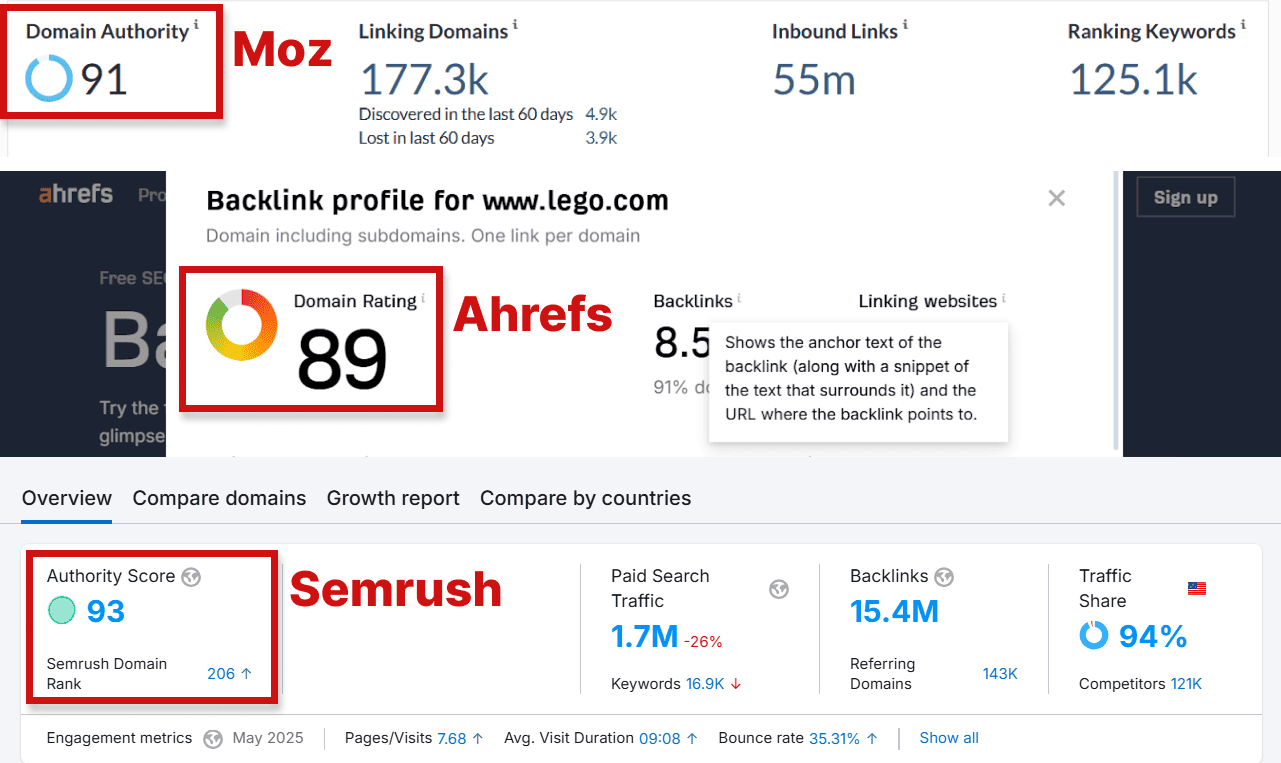
Why it matters: your link sits on a specific page, but the page inherits part of its potential from the domain it lives on. When you’re qualifying prospects at scale, domain strength helps you filter quickly before digging into page-level detail. To make things easier, here’s a quick comparison of these three domain strength metrics:
| Metric | Tool / Provider | Scale | What It Measures (high level) | How It’s Calculated (high level) | Best Use Case |
| Domain Authority (DA) | Moz | 0–100 | Predictive strength of a domain’s ability to rank based on link profile | Machine-learning model using linking root domains, quality/quantity patterns, and other link signals | Early screening, comparing sites in the same niche |
| Domain Rating (DR) | Ahrefs | 0–100 | Strength of a domain’s backlink profile in Ahrefs’ index | Looks at links from unique domains, their DR, and how link equity flows across the index | Prospect prioritization and measuring link equity growth |
| Authority Score | Semrush | 0–100 | Overall domain quality and authority | Uses backlinks, organic search data, and signals of naturalness and trust | Balancing link signals with traffic and quality checks |
Those link building metrics & tracking set flexible floors by niche and region (e.g., DR/DA/AS 30+ for emerging niches, 50+ for competitive finance or SaaS). Then, validate with page-level checks and relevance. For your own site, track the trend rather than obsessing over single jumps; steady growth in referring domains from credible sites should lift these scores over time. Use domain strength to sort your list, but don’t say yes based on this metric alone. Move to the page-level and relevance checks below before you pitch or publish.
2️⃣ Organic Traffic
Organic traffic is a reality check: do searchers actually visit this site – and ideally, this page – from Google? A site with healthy, stable traffic is usually safer and more effective than one with sky-high authority metrics but little search visibility.
Links from pages that already attract visitors can bring referral traffic immediately and tend to be indexed and valued faster. On the flip side, a domain whose traffic collapsed may be dealing with quality issues, thin content, or algorithmic-style problems. That doesn’t always kill the opportunity, but it raises the bar for scrutiny. To evaluate it, look at three things:
- Trend: Is traffic up, flat, or sliding over the past 6–12 months? A mild dip isn’t fatal (seasonality happens), but a long, sharp decline deserves caution.
- Country mix: Does the audience match your market? If you sell in the U.S. but the site is 90% traffic from countries you don’t serve, your link may not send the right signals or clicks.
- Page-level estimates: Check the traffic of the exact URL you’ll be placed on (or a close analog on the same site). A page with search demand beats a brand-new URL with no visibility.
Favor sites with stable or growing traffic and placement pages that already rank for relevant terms. If the perfect topic page doesn’t exist, pitch an angle that can attract searchers (not just a “links page”).
3️⃣ Anchor Text
Anchor text tells users and search engines what the target page is about. That’s powerful, which is why it’s also risky if you over-optimize. Focus on relevance and naturalness first, and treat anchors like part of the editorial conversation on the page. Types of anchors to keep the balance:
- Branded. Your company or product name (safest, most natural over time).
- URL / Naked. Your page URL is the anchor.
- Generic. “Learn more,” “this guide,” “source,” etc. (fine in moderation).
- Partial-match. Includes part of your target phrase with brand/context.
- Exact-match. The keyword phrase exactly (use sparingly and only when it’s truly natural in context).
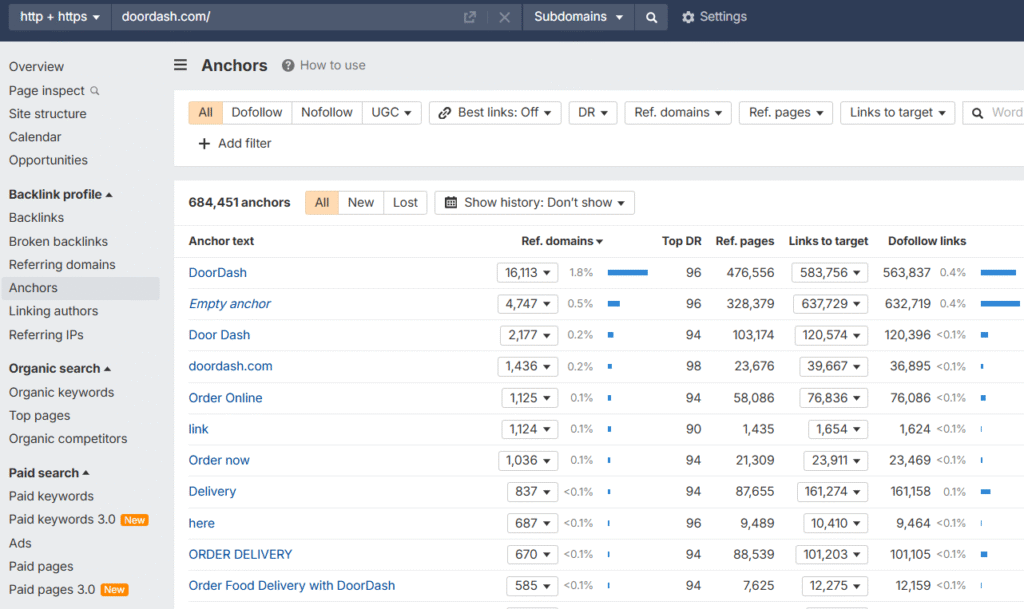
For example, a huge site like doordash.com has a mix of anchors. Because of its size, some of those links (and anchors) come from everyday users and aren’t tightly controlled. However, when building links, you should carefully plan the anchor text.
Before you pitch, scan the site’s existing outbound anchors. Are they mostly branded and partial-match within the editorial context? Good. Are there long strings of exact-match payday or casino anchors site-wide? Walk away. For your own profile, audit top anchors to ensure your brand and natural variations dominate, with only a small portion of exact-match anchors from high-quality, relevant pages.
When you suggest a copy or provide a brief, give the editor two or three natural anchor options. Aim for a brand or partial-match variation that fits the sentence naturally. If the text doesn’t look organic, rewrite the sentence — don’t force the anchor. To keep your anchor mix balanced and avoid over-optimization, you can structure safe variations using our anchor text generator before sending outreach proposals.
4️⃣ Number of Links
Counting links is easy; interpreting the count is harder. A spike in total backlinks can look exciting, but quality and diversity matter more than raw volume. A single link from a respected, relevant site can outperform dozens from thin directories or auto-generated pages.
For a prospect domain, look at how they build links: do they have a healthy, steady accumulation from varied sources, or do they add hundreds at once from predictable patterns (widgets, sitewide footers, or auto-approve platforms)? For your own site, focus on referring domains (covered next) and the types of pages linking in (editorial content beats navigational footers most of the time).
Set volume goals that emphasize credible sources. For example, “10 new referring domains this quarter where the placement page is topically aligned and gets at least some organic traffic.” This kind of target prevents chasing vanity counts.
5️⃣ Dofollow and Nofollow
The rel attribute tells crawlers how to treat a link. A typical, editorial link is “dofollow” (no rel attribute or rel=”follow”), while “nofollow,” “sponsored,” and “UGC” add qualifiers. A natural mix is healthy. A profile that is 95% dofollow can look as strange as one that’s 95% nofollow. You can check that ratio using tools like Ahrefs.
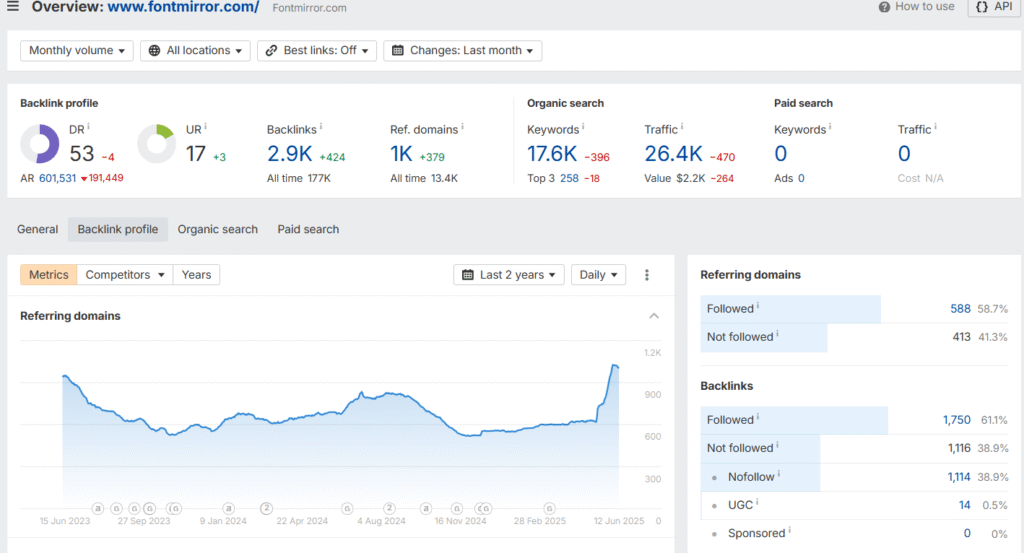
Check your own ratio at the domain level and for the specific page you’re building. For a prospect, sample a few recent posts – do they sprinkle “sponsored” on every external link? Are many outbound links nofollowed even inside editorial content? Context matters; news sites often use more nofollow, and forums or comment-heavy platforms label UGC. The question is whether editorial, in-content links are typically followed.
Don’t reject a great opportunity just because a site uses some nofollow, especially if the page can send relevant readers. But for your core link building, aim for editorial followed links placed in a meaningful context. If a site insists on “sponsored” for any brand mention, classify it as paid promotion – useful for awareness, not for link equity.
6️⃣ Page Strength
Page-level authority determines how much value a specific URL can pass right now. While domain strength sets the ceiling, page strength tells you what’s available today. Signals include the number and quality of referring domains to that page, internal links pointing to it, and whether the page ranks and receives organic traffic. How to evaluate it:
- Inbound links to the page. Even a new post on a DR 80 site won’t pass much if the page is orphaned.
- Internal links. Does the site interlink its articles well? A page with prominent internal links from strong, relevant pages is a winner.
- Indexation and rankings. If the page is indexed and already ranking for related queries, your link is more likely to be discovered and valued quickly.
Prefer URLs that the site will actually support – pages tied to ongoing topics, category “hubs,” or evergreen guides. If the page is new, ask whether it will be included in internal navigation or linked from older relevant pieces. For your own site, strengthen the pages that host outbound links to others; that helps you reciprocally build goodwill and a network of pages that get visited and shared.


7️⃣ Relevance of the Linking Page
Relevance bridges what users want and what search engines expect. You’re aiming for topical fit, intent match, and audience alignment. A daycare guide on a parenting blog makes sense; the same guide on a loans comparison site doesn’t – no matter the metrics. Three layers of relevance to check:
- Site-level. Is the website broadly about your topic or an adjacent area?
- Page-level. Is the article’s subject tightly related to your page?
- Paragraph-level. Does the sentence around your link make sense with your anchor and destination?
Read the placement page like a real reader. Would adding your link help someone complete a task or understand a point? If you need to wedge it in with awkward anchors or off-topic paragraphs, the fit is wrong. Look for intent alignment too: if your target page is a buyer’s guide, links from other buyer’s guides or decision content will usually do better than links from general opinion pieces.
8️⃣ Referring Domains and Backlink Totals
Referring domains and backlinks are often confused. Backlinks are the total count of links pointing to your site; referring domains are the number of unique websites that link to you. For authority building, the diversity of referring domains typically outweighs raw link count.
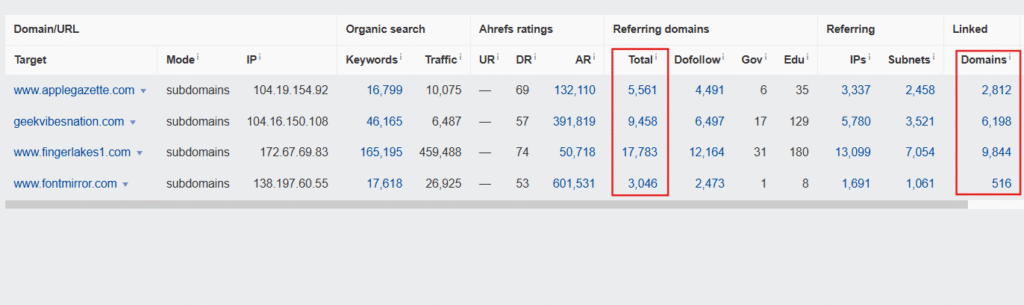
Ten links from one site help, but they won’t have the same accelerating effect as ten links from ten different, credible sites. Diversity broadens your site’s neighborhood and makes your profile look more natural. To evaluate it, use:
- Your site. Track new referring domains per month/quarter, not just total links. Aim for steady, credible growth from a variety of topical sources.
- Prospects. For a domain you’re considering, check its referring domains to backlinks ratio. If a site has an extreme number of backlinks but relatively few referring domains, it could be heavy on sitewide or template links.
- Competitors. Compare the overlap and gaps. Which domains link to them but not to you? Those are priority prospects.
Build a pipeline of varied sites – industry publications, niche blogs, associations, educational resources, and relevant communities. Avoid deals that package dozens of links from the same domain (sidebar or footer blasts). One high-quality editorial link per domain is usually enough; if you add a second, make sure it’s on a different page with a different context.
9️⃣ Link Position on the Page
Where your link sits on the page affects both visibility and value. In most cases, in-content links (especially those placed earlier in the main body) perform better than links buried in footers, sidebars, or long “resources” lists.
Open a handful of recent articles on the site. Where do external links appear? Are they woven into sentences and supported by context, or crammed into a “Partners” block at the end? Check whether the site uses “jump to” tables that push readers straight past your link position. Also, notice whether the link is surrounded by descriptive language that signals what users will get when they click.
When you pitch or negotiate, ask for in-content placement near the first or second relevant section. Offer to supply a sentence that naturally introduces the link – editors appreciate the help. If a site can only place you in a generic list or a boilerplate footer, reconsider unless the brand exposure alone is worth it.
🔟 Toxicity and Spam Score
Risk management is part of link building. Tools try to quantify it with metrics like Spam Score (Moz) and Toxicity (Semrush). These aren’t perfect, but they’re useful as alerts. Pair them with manual checks: unnatural anchors, thin content, scraped articles, and networks of look-alike sites. Evaluate link building metrics by:
- Surface scan. Does the site host adult, casino, or pharma anchors in unrelated posts? Are there many exact-match anchors pointing to low-quality destinations?
- Content quality. Are the articles coherent and original, or stitched together from other sites?
- Outbound link patterns. If every post links out to multiple commercial pages with money-keyword anchors, assume they sell links.
- Historical traffic. A sudden crash combined with aggressive outbound patterns is a red flag.
Avoid high-risk placements. For your own profile, don’t panic if a few questionable links appear – everyone collects some noise over time. Focus first on earning better links that outweigh the bad. If you must, consider disavowing at the domain level for truly egregious cases, but do this sparingly and only after careful review.
🧩 Pulling It All Together: A Practical Workflow
Here’s a simple, repeatable way to use the ten link building success metrics above without drowning in dashboards. Keep it lightweight and focused:
- Shortlist by domain strength and topical fit. Start with DA/DR/Authority Score floors appropriate to your niche and a quick relevance read.
- Validate with organic traffic. Favor sites with stable traffic and, ideally, placement pages that already rank for related terms.
- Check page strength. Look for internal links to the placement page, previous links pointing to it, and basic ranking signals.
- Scan anchors and outbound patterns. You want editorial, brand-leaning anchors in context – not exact-match link dumps.
- Confirm link type and position. Aim for followed, in-content, and early in the body.
- Assess risk. Use toxicity/spam indicators as warnings, then trust your manual review.
- Track referring domains over raw backlinks. Diversity beats volume; strive for new, credible domains each month.
- Measure outcomes. Record referral clicks, ranking movement for targeted pages, and indexation speed – these are the real-world validations of your choices.
This workflow keeps you honest: you don’t chase a single eye-catching number, and you keep the end goal in sight – earning links that help users and lift visibility.
🏁 Final Thoughts: Track What Matters, Build What Lasts
The best link builders aren’t obsessed with a single score – they read the full picture. Domain strength gets you in the ballpark, organic traffic and page strength tell you whether a page can actually help, relevance and intent make your link useful, anchors keep everything natural, and link type, position, and toxicity protect you from avoidable risks.
Use the ten link building metrics in this guide as a practical checklist for your site, your prospect list, and your competitors. Keep your thresholds flexible by niche and market. Favor editorial context over shortcuts. If you do that consistently – week after week – you’ll build a link profile that attracts real readers, stands up to scrutiny, and steadily improves your visibility. Or you can always ask NeedMyLink to do it for you.


