


Organic SEO, also known as natural/organic search optimization, is the process of improving a website’s visibility on search engine results pages (SERPs) without relying on paid advertising. It optimizes various aspects of a website, such as its content, structure, and backlink profile, to grow its organic ranking and attract targeted organic traffic. Using relevant keywords, creating high-quality content, optimizing meta tags, and building quality backlinks are primary strategies for effective organic SEO.
One of the biggest advantages of organic SEO is its long-term sustainability. While it may take longer to see results than paid advertising, the benefits often last longer and can provide consistent traffic without ongoing advertising costs.
❓ What Is Organic SEO?
Organic search engine optimization is the practice of naturally improving a website’s visibility in search engine results without paying for advertising. It involves optimizing your website’s content, structure, and technical elements to rank higher in search engine results pages (SERPs) for specific keywords and phrases.
Unlike paid search advertising, organic SEO focuses on earning traffic through unpaid or “natural” search rankings. This process requires understanding SEO algorithms, creating high-quality content and implementing various optimization techniques that align with search engine guidelines and best practices.
The main components of organic SEO include:
- On-page optimization (content, meta descriptions, title tags).
- Technical SEO (site speed, mobile-friendliness, site structure).
- Off-page SEO (backlinks, social signals, online reputation).
- Local SEO (Google My Business, local citations).
- Content strategy (keyword research, content creation, user intent).
⚙️ The Process of Organic SEO: How It Works
Core Components of Organic SEO
🔹 1. Technical Foundation
- Website architecture optimization.
- Mobile responsiveness implementation.
- Page speed enhancement.
- XML sitemap creation.
- Robots.txt configuration.
🔹 2. On-Page Elements
- Strategic keyword placement.
- Meta description optimization.
- Header tag hierarchy.
- Image alt text implementation.
- Internal linking structure.


⚙️ The Search Engine Evaluation Process
Search engines employ sophisticated crawlers that:
- Discover new web pages.
- Analyze content relevance.
- Assess user engagement signals.
- Evaluate site structure.
- Monitor site performance metrics.
Search engines prioritize websites that demonstrate expertise, authoritativeness, and trustworthiness (E-A-T) through their content and technical implementation.
Quality Signals That Impact Rankings
| User Experience Metrics | Content Quality Indicators |
| Bounce rate | Comprehensive coverage |
| Time on site | Regular updates |
| Pages per session | Proper formatting |
| Click-through rate | Relevant internal links |
| Mobile usability | Multimedia integration |
The effectiveness of organic SEO relies heavily on maintaining consistency across these elements while adapting to search engine algorithm updates and evolving user behaviors.
➕ The Positive Impacts of Using Organic SEO
Just think about having a marketing plan that evolves as your enterprise expands and serves as a nonstop workhorse loyal enough not to demand additional incentives. That is the power of organic SEO – a tool that ranks your website on the search engine results but also changes how your target audience finds you. It’s far different from buying a paid search ad. Organic SEO creates a world where your brand is the solution to searches made:
1️⃣ Gives you authority in your field.
How about having a name that appears every time someone searches for information on your field? That’s what organic SEO does – it establishes your character. Those who find their desired content consistently placed at the top wouldn’t go elsewhere for that information – they’d go to you.
2️⃣ Your success doesn’t depend on a budget.
Paid ads are similar to rent – they make you stay seen. Organic SEO is more like owning a piece of property. Ideally, each piece of optimized content you develop is an investment growing in value over time. This is marketing, which continues to give results into the future even if you stop making your spending.
3️⃣ You attract people who want to find you.
Organic search engine optimization can be likened to a magnet. It attracts receivers searching for what you have to offer. These aren’t mere clicks, but potential customers with purpose, ready to interact on a box and pad.
⚖️ Understanding the Gap Between Paid Search and Organic SEO
Advertising through paid search delivers instant visibility, while organic SEO generates traffic through natural search performance. The key distinction is in method and timing: paid search yields fast results but needs ongoing spending, while organic optimization requires more time but offers lasting advantages.
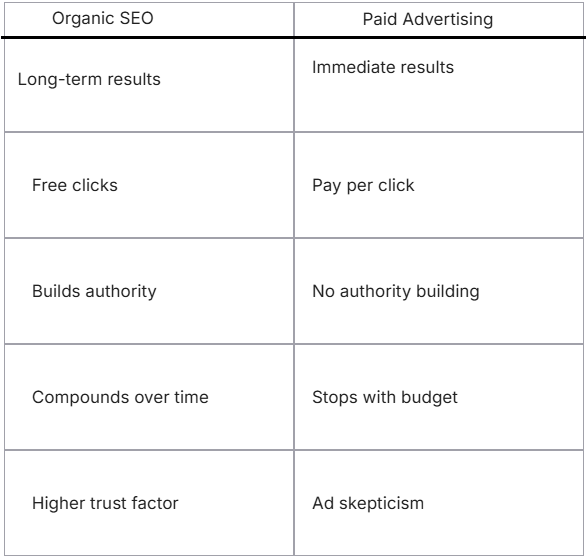
Organic SEO optimization builds a lasting brand. Do you want to be seen for a day, or do you want your customers to associate your brand with convenience for years? Following that, organic search engine optimization builds constant visibility and transforms a conventional browser into a steady shopper and promoter of the brand.
🔑 Key Reasons Organic SEO Should Be a Priority
🔸 Affordable promotion of web traffic
- It drives meaningful and lasting traffic without having to continue using ads.
- Offers exponential returns on the initial investment made.
- When analyzing the costs associated with customer acquisition, the impact is much lower over the long run.
🔸 Superior User Engagement
- Brings highly relevant organic traffic.
- Enhance user appraisal/assessment and approval.
- Extends customer retention time on the site and increases the chances of converting.
🔸 Website Technical Enhancements
- Enriches the site layout and the run-time characteristics.
- It improves the mobile layout.
- Updates the technical basis of advancement.
🔸 New Digital Footprint
- Growth in presence on more social media sites.
- Creates a full-fledged content environment.
- Expands the contact point, the achievement of which targets the demographic group.
🔸 Measurable Business Impact
- Can trace conversion rate from consumers through attribution.
- Supports the utilization of data in management decision-making.
Wait no more. If you don’t know where to begin organic search engine optimization, you can always get advice from our expert link-building team.
⏰ Organic SEO Results: Expected Time to See Impact
Organic SEO techniques are a long-term investment that requires patience and consistent effort to see meaningful results.
✔️ Initial Phase (1-3 months)
- Technical optimizations begin showing an effect.
- Search engines start recognizing site improvements.
- Initial indexing of new content occurs.
- Basic ranking fluctuations may be observed.
✔️ Development Phase (3-6 months)
- Gradual improvement in search rankings.
- Increased visibility for targeted keywords.
- Growing organic traffic numbers.
- Better engagement metrics.
✔️ Establishment Phase (6-12 months)
- Massive ranking improvements.
- Stable organic traffic growth.
- Enhanced domain authority.
- Stronger competitive position.
✔️ Long-term Impact (12+ months)
- Sustainable traffic patterns.
- Established market presence.
- Compound effect on visibility.
- Reduced dependency on paid advertising.
It may take several months before the first actual outcomes are noticeable, but the long-term advantages of maintaining a blog, continuing to attract audiences, increasing brand recognition, and building authority make the process worthwhile.
🔢 Steps to Optimize Your Website for Organic SEO
Looking for those factors that can have a positive impact on your website search engine ranking? We’ve got you covered! Here’s a step-by-step guide for those regardless basic tasks that, when completed, would help to level up your website and attract more attention from search engines. It is better to consider them as the basic elements of organic search engine optimization. We assure you that with all these in place, you will be on the right track to realizing a website that is fully appreciated by both the search engines and the visitors.
✅ Off-Page SEO
Off-page SEO focuses on activities outside your website that influence its credibility, authority, and ranking in search engine results pages (SERPs).
⛓️ Backlink Building: The Backbone of Off-Page SEO
Backlinks, also referred to as inbound links, are links placed on third-party websites pointing towards your site. To a website such as these search engines, high-quality backlinks are seen as endorsements that (from those sites) your content is worth a visit.
- Quality over Quantity: Instead of numerous links from any site, the links have to be from authoritative and relevant sites, such as blogs and news sites.
- Natural Link Building: Produce content that can be naturally linked, for example an infographic, a case study or a guide.
- Guest Posting: The other is to write articles for other reliable blogs and websites that provide links to your site.
- Broken Link Outreach: Go to other websites, find links that no longer work, and replace them with your articles.
Impact: Backlinks are one of the most important factors in raising the site’s and its domain’s authority in SERP.
⛓️ Brand Mentions: Creating recognition and trust from the customers
Brand mentions are a situation where your brand is mentioned online, it could be with a link or without it. Linked and unlinked mentions work side by side to increase the site’s authority by informing search engines your site is relevant and trustworthy.
- Online PR: Partner with reporters and bloggers to announce your company in sector niche articles with link inserts or journalists’ posts on social networks.
- Social Media Engagement: Encourage people to talk about your brand by tweeting, linking, posting, and sharing on media such as Twitter, LinkedIn, and Instagram.
- Monitor Mentions: You should utilize search engines like Google Alerts or Brand24 to capture unlinked mentions and then proceed to request backlinks.
Impact: Brand mentions build a good image online and commend your business to search engines, telling them people love your business.
⛓️ On-Page SEO
Some key components combine to create a truly effective on-page SEO state that signals to search engines that the page’s contents are worthy and closely related to a user’s search query.
- Title Tags: Title tags are clickable headlines in search results and they strongly influence both SEO and user behaviour. They should be keyword-optimized, short, and compelling to increase clicks. Instead of writing them manually each time, you can use an AI meta title generator to quickly create properly structured titles based on target keywords.
- Meta Descriptions: While meta descriptions are not a direct ranking factor, a well-written one significantly improves click-through rate (CTR). It should clearly summarize the page content and naturally include primary terms. A practical approach is using a AI meta description generator to produce concise and readable snippets at scale.
- Header tags structure your content in a clear hierarchy so both users and search engines can easily understand the page. Ideally, the primary keyword belongs in the H1, while subtopics and related terms fit naturally into H2 and H3 headings along with supporting secondary keywords in the text. To plan this structure faster, you can use an SEO outline generator to build a logical heading framework before writing.
- URL Structure: Better SEO performance comes with clean and descriptive internal URLs. Short URLs including keywords that are readable by users and search engines.
- Image Optimization: By reducing file size, choosing descriptive filenames, and using alternative text, you’ll optimize performance and give search engines a better understanding of images.
❗️ Prioritize Search Intent in Your SEO Strategy
Search intent refers to the reason or motivation behind a user’s search, which can be classified into four main categories. The primary categories of domains are informational, navigational, commercial and finally the transactional. When you base your SEO strategy with search intent, you are able to develop content that will positively address users’ needs and thereby enhance your search engine optimization.
For instance, if your targeted audience is likely to be looking for information given a specific topic, the best way to keep them engaged is by creating well-researched informative blog posts on the said topic.
On the other hand, if your audience is searching for anything related to products or services, then make your pages relevant for both commercial and transactional contexts and ensure that your business’s products & services are mentioned with a call to action. The idea is that, focusing on search intent, you enhance the possibility to attract traffic with high potential for conversion and, thus create a stable and loyal audience.
🔍 The Importance of Keyword Research
Keyword research is one of the prerequisites to any successful SEO campaign. It entails determining keywords that may be entered into search engines. Search string refers to the phrases users use in a search for certain information, goods, and services. By investing in keyword research, you will be able to determine the behavior of your target audience in their search.
For analysis, you can use platforms like Google Keyword Planner, SEMrush, or Ahrefs, and combine them with a keyword suggestion tool to expand ideas and discover additional relevant queries. After building your keyword list, place them naturally in page content, titles, meta tags, and URLs so search engines clearly understand your topic and can rank your pages appropriately.
📋 Conclusion
In conclusion, it becomes clear that organic SEO techniques are the keys to success for businesses willing to increase their online presence, get targeted traffic, and, achieve sustained results. Organic SEO implements best practices and fundamental components that work as a springboard to gaining credibility and authority across your niche.
Additionally, achieving search intent and proper keyword research enable you to create the necessary content for your audience and increase your chances of appearing higher in SERP. In other words, consistency in SEO, understanding algorithm changes, and shifts in consumer behavior while working on the project will help sustain growth for your business.
Finally, the strength of achieving great results through organic SEO techniques depends on the audience with whom you build a trusting relationship and penetrate with your proposal, which is already relevant today and in the future for your business.


