


Marketing budgets always go faster than we’d wish they would. So, the question really is: are you interested in sustainable growth that will take time, or instant gratification that will look good in the short term? In order to make that decision, you must have a clear idea of what is the difference between SEO and SEM.
SEO builds organic visibility over time, while SEM buys paid visibility for the queries you want. For example, if you are launching a fitness app, SEO provides you with visitors who search for “best workout plan,” while SEM helps run ads for “download fitness app today.” In this guide, we will explain what is SEO and SEM, present a SEM vs. SEO comparison table, and even provide step-by-step strategies you can start using right away.
❓ What Is SEO?
SEO (Search Engine Optimization) is the way that you find your way into Google’s free listings – no ad budget, just smart optimization, building your site as an authority resource. It snowballs – the work that goes into creating the site can continue to reward you for years to come.
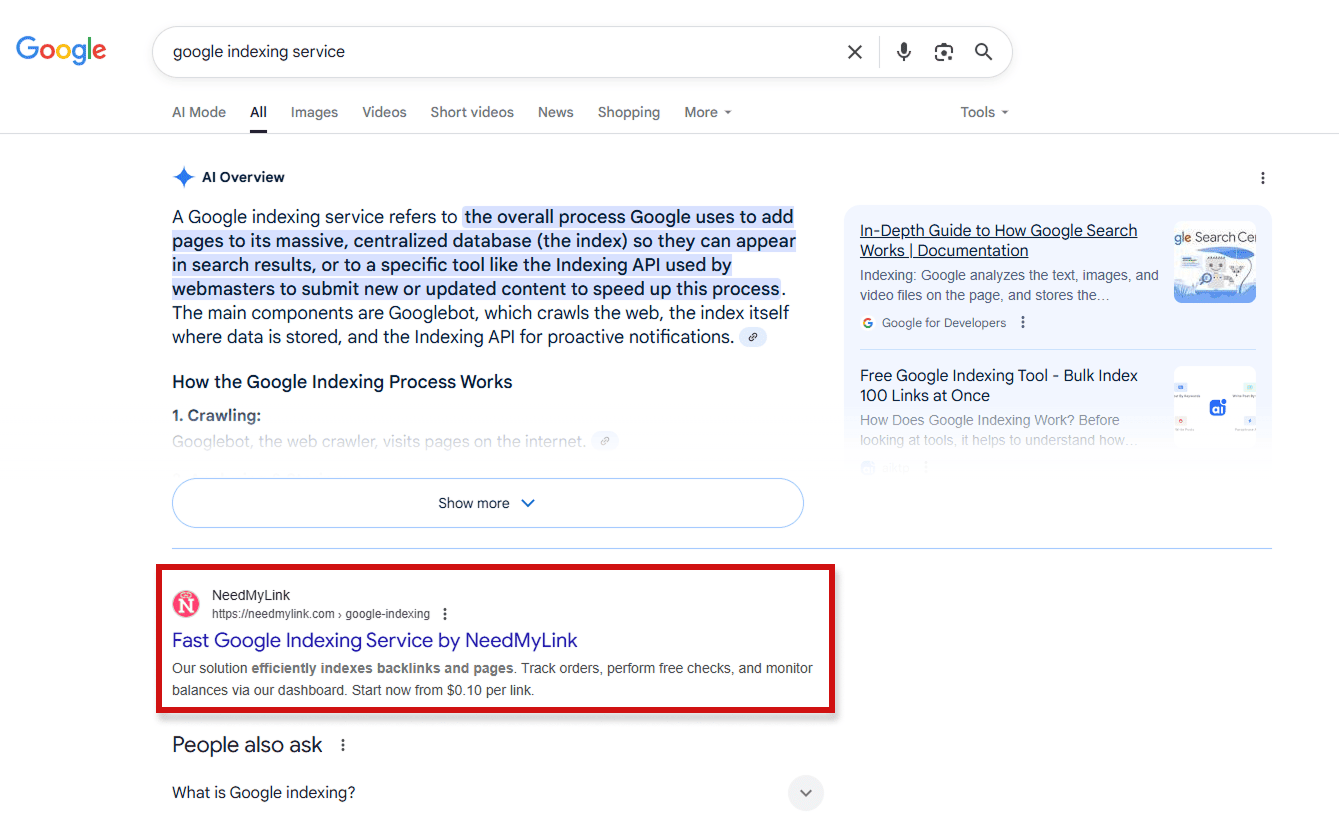
Through consistent SEO work, our indexing services successfully achieved the #1 position. It explains how search engines discover, understand, and rank your pages. That is:
- Technical foundation. Making it possible for search engines to find and understand your site. That is crawlability, proper indexation, Core Web Vitals in green, and structured data that tells Google what’s what.
- On-page signals. The cues you provide on each page: aligning search intent, crafting click-worthy titles and meta descriptions, organizing content with distinct headings, and integrating smart internal links.
- Content strength. Not simple words on a page, but content with depth, up-to-date information, clear answers to questions, and additions like images, charts, or videos.
- Off-page credibility. The outside world vouches for you. Think of relevant backlinks, brand mentions, and other signals that prove to search engines you’re a trusted authority.
SEO has to be on your agenda from day one. Don’t expect overnight wonder – spend 2–3 months in SEO and you’ll start seeing snowballing growth. You need to run a crawl every now and then with Screaming Frog to see whether Google can discover your pages or not. Most agencies do this audit under the larger SEO SEM services, integrating organic with paid campaigns so that you can choose the best mix for your goals.
⚙️ How Does SEO Work?
This is what happens behind the scenes: spiders browse through your site, save the info in an index, and later rank pages according to how helpful and relevant they seem. Your job is to produce the best answers that are easy to find, understand, and trust.
When you execute this well across clusters of related topics, growth actually begins to snowball. That’s also why people sometimes conflate Search Engine Optimization and Search Engine Marketing with one another. Both organic and paid can be working toward the same business objectives – but the mechanics themselves are pretty different.
📢 SEM: Paid Visibility on Demand
Search Engine Marketing (SEM) is paid search advertising, which comes in a variety of formats, such as PPC campaigns, Google Shopping ads, display banners, remarketing and retargeting, branded search ads, local search promotions, YouTube video ads, and placements via Bing or Microsoft Ads. Within the scope of this article, we focus on the formats that show on the top of Google for chosen queries, providing visibility the instant your campaigns are live.
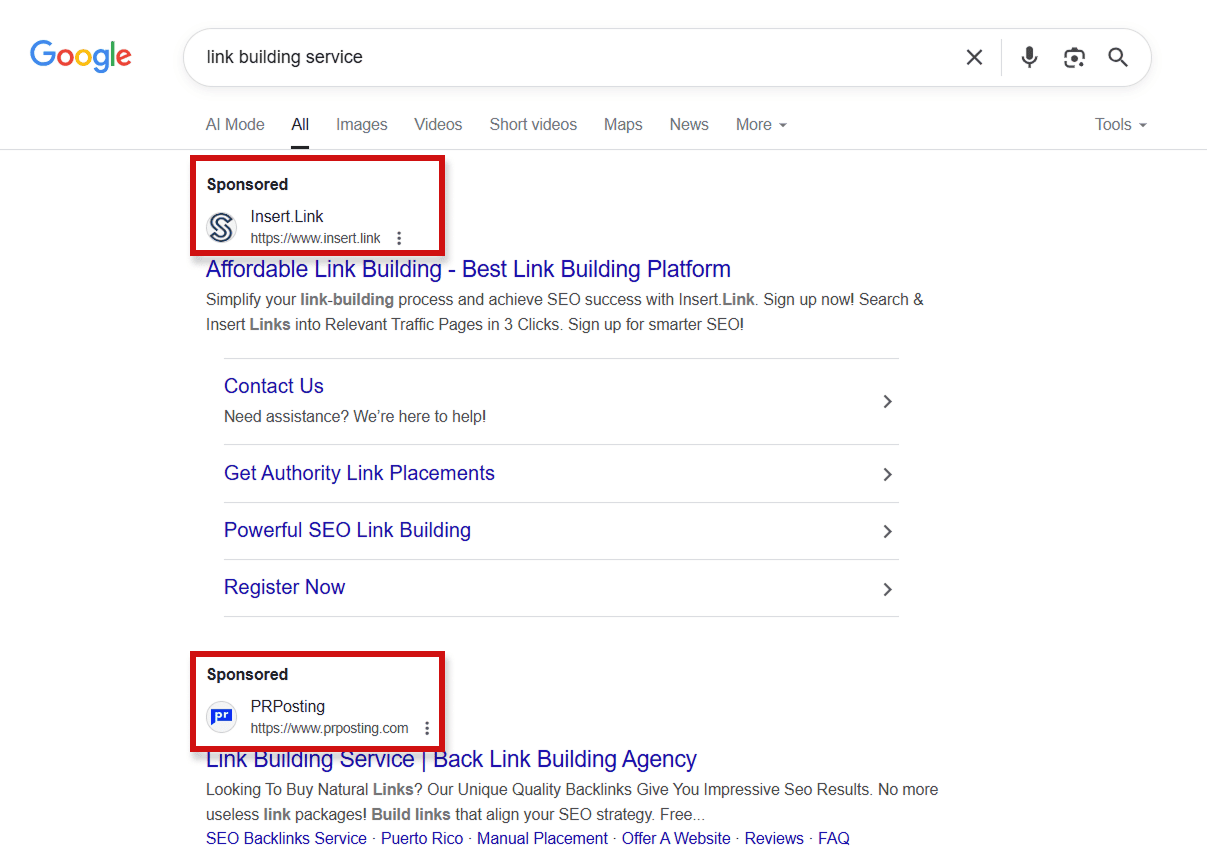
It’s easy to run search ads in theory: choose your keywords, develop some ads, and set a budget. And then stand back and watch the clicks come pouring in (hopefully to a landing page that actually converts). So how does SEM operate?
🔍 Behind the Scenes: How SEM Really Works?
Every time a user searches by typing, Google hosts an instant auction in the background to determine where the ads appear initially. Your bid determines how visible your ad is, how relevant it is, and how much impact your assets are expected to have. You pay only for clicks. You’ll choose:
- Match types (broad, phrase, exact) and negative keywords.
- Bidding (manual CPC or automatic “Smart Bidding” strategies).
- Budgets (daily caps and campaign-level priorities).
- Creatives & assets (headlines, descriptions, sitelinks, callouts, lead forms).
Campaigns appear in the SERP as sponsored ads, map ads (for local search), or product listings (for shopping). Because you have a spend and target control, SEM is excellent for offer testing, capturing early demand, and marketing time-limited offers. Don’t allow “failing” campaigns to die prematurely, though – allow them to make it through at least 2–3 weeks of testing before calling them a failure.
💰 How Much Should You Allocate for SEM?
The answer will depend upon the size of business, industry, location, revenue, and overall marketing plan. Most companies, based on a WebFX survey, allocate between 6% and 25% of the marketing budget for SEM.
If you’re a local plumber or bakery, $300–$1,000 in monthly advertising tends to do the trick without eating the wallet. On the other hand, a luxury law firm in a high-traffic city might cost at least $5,000 to keep in the fray. In extremely competitive or high-demand industries (i.e., law, finance, healthcare, or e-commerce), budgets of over $10,000 are common.
Effective SEM also requires ongoing investment in figuring out what people want, testing ad copy, landing page optimization, and monitoring conversions. The best campaigns align budgets with the stage of business, growth goals, and competitiveness, so that every dollar spent returns measurable results.


⏳ How Long Does SEM Take?
Paid ads can start driving results the very day your campaigns go live. However, performance depends heavily on your bidding strategy. If you’re using Smart Bidding, expect a learning period while Google’s algorithm gathers data. Google’s Smart Bidding usually needs about 50 conversions (or a few buying cycles) before it really knows what it’s doing. During this phase, results may fluctuate as the system experiments with different bids, audiences, devices, and queries.
If you’re running manual CPC, you’ll still need time to test keywords, adjust bids, refine ad copy, and collect enough data to make informed decisions. In both cases, the first few weeks should be viewed as an investment in data acquisition. Once the learning curve stabilizes, campaigns typically deliver far more predictable and scalable ROI.
🚀 How Can SEM Help You?
SEM offers you velocity and control. You can intercept high-intent searches immediately, refine messaging in real-time, and scale successful campaigns. Use SEM to:
- Rapidly prove out offers. Experiment with headlines, value props, and calls-to-action. Roll the winners into SEO pages, landing pages, and product copy.
- Fill early demand. Since new sites rarely rank overnight, ads keep your pipeline warm while organic visibility is built.
- Target by intent and location. Display ads when and where they are most impactful – perfect for local businesses and service providers.
- Control your content strategy. Reports can reveal converting search terms, and you can then expand upon them into high-performing organic content.
Paid ads allow you to learn faster, reduce guessing, and keep business rolling in, while SEO strengths grow over time.
⚔️ SEO vs. SEM: Discovering Gaps and Overlaps
The most significant difference between SEM and SEO is how you achieve visibility. SEO establishes an evergreen organic presence that you do not pay for per click, but SEM provides you with instant visibility with complete control over time and cost. A holiday gift campaign can be executed via SEM by an e-commerce company, but SEO can be utilized to establish authority for evergreen searches such as “eco-friendly backpacks.” To analyze them, below is a comparison table – SEO vs. SEM at a glance:
| Factor | SEO | SEM |
| Cost model | Content, technical effort, tools, and experts – no CPC. | Continuous media investment (CPC/CPA) plus administration. |
| Time to impact | Gradual initiation, followed by compounding returns. | Instant impressions/clicks upon launch. |
| Control | Lower control over timing; high control over on-site experience. | High control over bids, budgets, messaging, and targeting. |
| Data feedback | Slower, but deep qualitative signals over time. | Fast, granular testing data for queries and creatives. |
| Best use | Evergreen expansion, authority, and lower blended CAC. | Launches, promotions, market tests, and exact demand capture. |
There is no need for a discourse on SEM vs. SEO marketing, because they are complementary. SEO produces long-term, sustained growth, while SEM generates immediate, manageable returns. The optimum strategy leverages both – using SEM to exploit short-term opportunities and learn from them, and SEO for building long-term authority and compounding traffic over time.
💸 Cost Comparison: SEO vs. SEM
When reading “What is SEM SEO marketing?” guides, it’s easy to assume SEO is low-cost simply because you’re not paying for ads. That’s a misconception. While SEO can be more cost-effective than relying solely on paid promotion over the long run, it still requires steady investment.
With SEO, most investment is in experience and implementation, including site analysis, content development, writing, design, development, link building, and specialty tools. You’re not investing in every click, but you’re always investing in people and processes that build organic presence.
SEM, however, is click spend-based. Most of the budget goes towards clicks, along with ongoing optimization, creative replenishment, and tracking. Here is a sample of the way in which the pages were promoted to the top through SEO, and below, there is an ad.
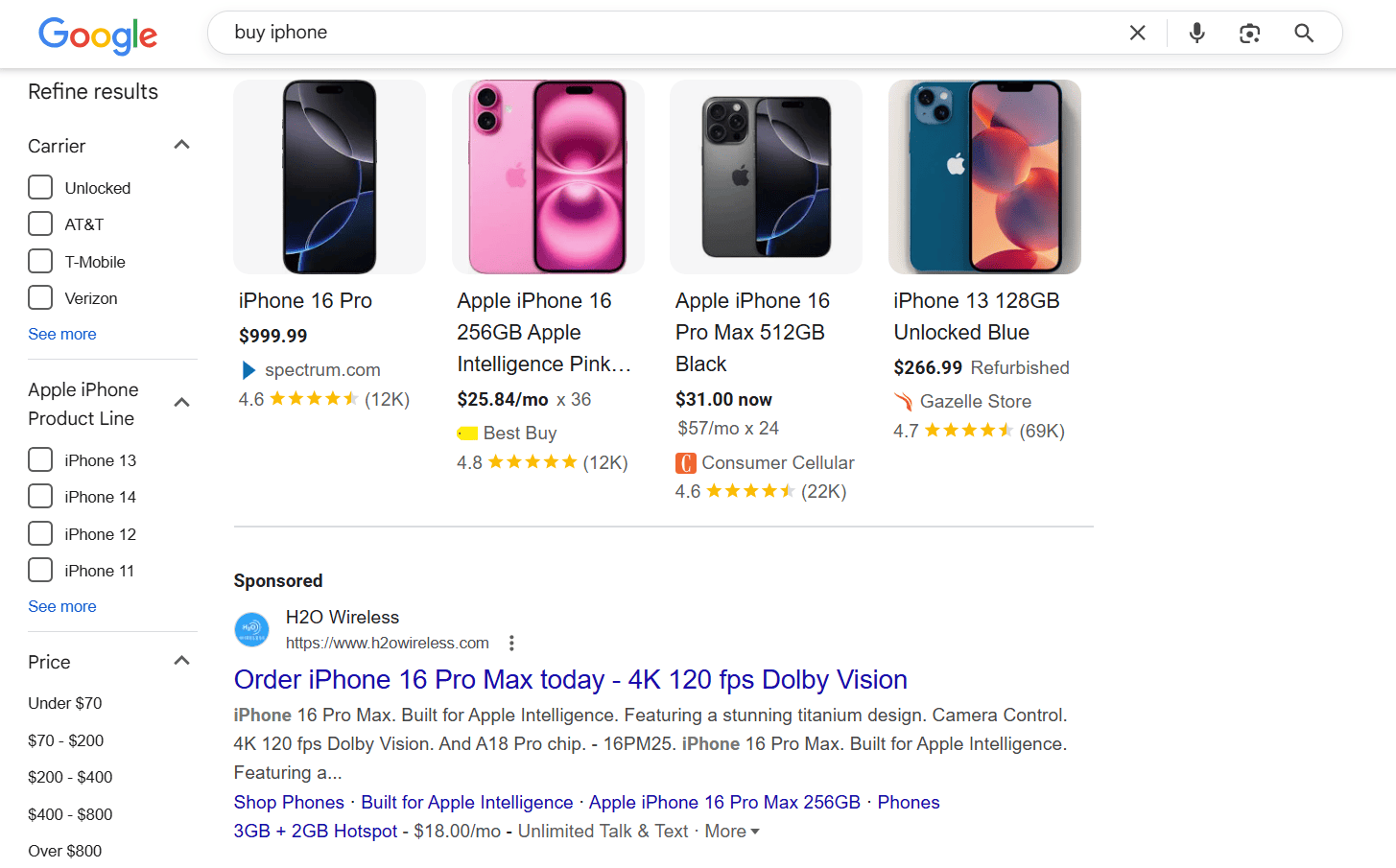
In reality, monthly expenses on SEO and SEM tend to fall in a comparable bracket. For the small business, it can begin at $500 per month and increase proportionally with the passage of time, depending on the competitiveness of an industry, desired objectives, and available budget.
🤝 Can SEO and SEM Work Together?
In fact, using both is generally the fastest and safest path to profit. That’s why marketers so frequently ask about the SEO and SEM meaning together before deciding how much to budget. Each one is a separate facet of the puzzle, but together they support one another. These are a few proven methods in which they complement one another:
- Launch plan. Use SEM to capture demand immediately and identify which queries, audiences, and messages are most effective in converting. At the same time, start building SEO pillar content around those insights so you’re investing in organic visibility that your market actually values.
- Content validation. Test headlines, angles, and offers with paid search before spending money. Once you know what performs, roll winners into organic landing pages and blog posts for longer-running performance.
- Coverage strategy. Purchase top ad positions on high-intent, competitive commercial terms where SEO will rank more slowly. In the meantime, allow organic content to establish your presence for information queries, category pages, and long-tail searches.
- Data loop. SEM provides rapid, nuanced performance data; SEO uses that feedback to tune up content strategy. This creates a virtuous cycle of enhanced targeting, stronger content, and reduced blended acquisition cost over time.
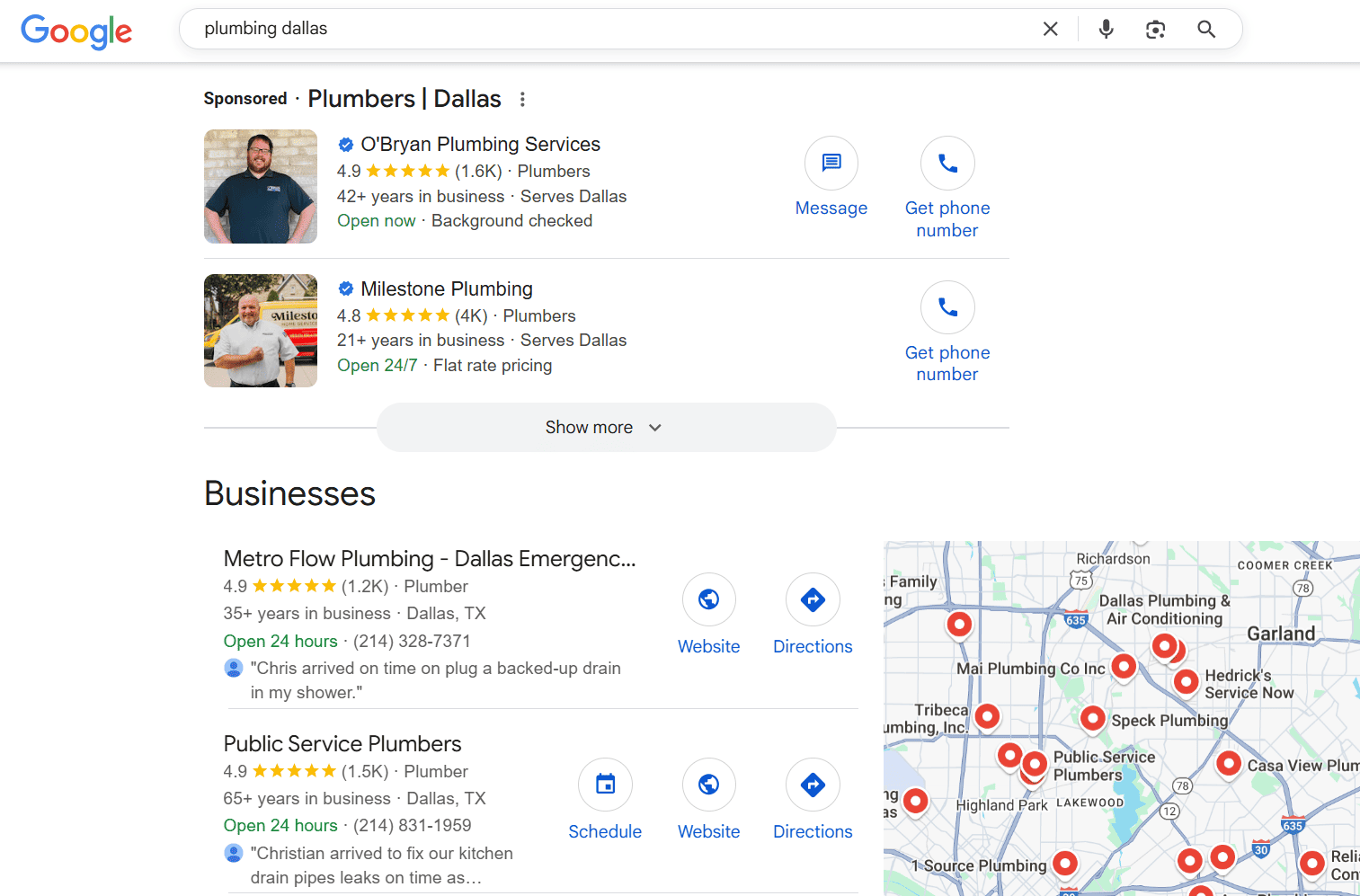
If you’ve ever been searching for what is SEM and SEO strategies combined, you need to think in sprints and compounding returns. Paid advertising gives instantaneous feedback and visibility, but SEO takes the learnings and builds long-term authority. Both of them create a search engine presence that is durable as well as scalable.
☝️ When to Use Only SEO?
Use SEO when your budget is limited, your topic is long-tail and evergreen, and your sales process allows compounding returns over time. In these situations, the long-term organic value outweighs the short-term gratification of paid ads. Double down on SEO in the following cases:
- Education-driven categories. If you’re working in a market that cares about trust and depth (such as healthcare, finance, SaaS, or B2B services), creating authoritative content and earning backlinks will pay you many years after release.
- Well-regarded content and dev resources. If you have a solid team of writers, designers, SEO specialists, and developers, you can consistently produce optimized content, technical tweaks, and digital assets that search engines love.
- Organic base established. If you are already ranking for early-stage searches (like information or “how-to” searches), you can then expand into adjacent keyword clusters and move up the funnel to higher commercial intent.
- Evergreen products. Products and services that have regular, ongoing demand (like accounting software, fitness plans, or legal services) benefit from SEO because the content remains valid for years, compounding visitors without repeat ad spend.
- Longer sales cycles. Customers who thoroughly research prior to purchasing will naturally view your brand multiple times. SEO gets you on the map during all that without paying for each click.
SEO-only campaigns are best suited for businesses with the patience to wait for expansion, consistently invest in content and technical endeavors, and appreciate enduring authority over fleeting traffic spikes.
🎯 Are You Ready for SEM Marketing?
You’re ready to invest in SEM when you have sound tracking in place, a genuine budget, and landing pages designed to convert clicks into money. Without these, even the best-looking campaigns will struggle. This is how you measure your SEM readiness:
- Clear goals. Define success before you go live. Do you have to drive a specific number of leads? Achieve a target CPA? Own particular geographies? These are the metrics that drive bidding strategy and campaign composition.
- Reliable tracking. Conversion tracking is non-negotiable. Set up pixel-based events, assign values where possible, and import offline conversions (such as phone calls or CRM deals) if they are relevant to your sales process. Without tracking, you’re flying blind.
- Optimized landing pages. The ad can get the click, but landing pages get the customer. They must be fast-loading, mobile-first, and message-matched to ad copy. Add obvious CTAs, trust signals, and streamline the form/checkout process to drive maximum conversion rates.
- Budget strategy. Budget enough to obtain statistically significant data. Underbudgeting SEM prevents breaking out of the learning phase successfully. Commit a budget that will allow enough traffic to reach statistically considerable data levels.
- Team and process. Someone must own the account, whether internal or agency-side. Weekly reviews, testing frameworks, and iterative optimization are what separate profitable SEM programs from wasted spend.
SEM is about having the systems, assets, and processes to capture, measure, and scale demand efficiently. When those are in place, SEM becomes one of the fastest levers for growth.
📝 Final Takeaway
SEO and SEM each add their respective strengths to your marketing. SEO is all about building organic visibility through the means of quality content, technical optimization, and authority, a strategy that takes time but yields slow, compounding growth. SEM generates instant visibility through keyword bidding and paying for ads. This approach yields rapid, quantifiable results and valuable test data but requires a constant budget.
Now that you are aware of the main search engine marketing vs. SEO differences, it’s time to apply this insight. NeedMyLink’s specialists are here to assist you in achieving this balance. Ready to drive your search marketing to new heights? Get in touch with NeedMyLink today and begin working on a successful plan for your company.
⁉️ FAQ: SEO and SEM – Common questions and answers
-
Can SEO and SEM compete with each other on the same page?
No, they exist together. If your ad and your organic result are displayed at the same time, you have more listings in Google. Having both search engine optimization search engine marketing increases overall clicks, rather than stealing them away. You basically have both – a large billboard (SEM) and a solid word-of-mouth (SEO).
-
Do users necessarily care whether they click an ad or an organic result?
Depends. Some people avoid ads on principle, while others click the first thing they find if it appears to be helpful. Mobile ads blend in more smoothly, and thus, there are more click-throughs. The actual difference between SEO and SEM is trust: organic clicks convert better in the long run since users perceive them as more “genuine.”
-
What if neither SEO SEM works?
If neither of these works, it’s usually not a channel problem but a conversion problem. Ensure your landing pages are tidy, mobile-friendly, and engaging. You may also need to revisit your offer, price point, or audience targeting. Fix the bucket before filling it with SEO SEM marketing.


