








Results of Working with Us
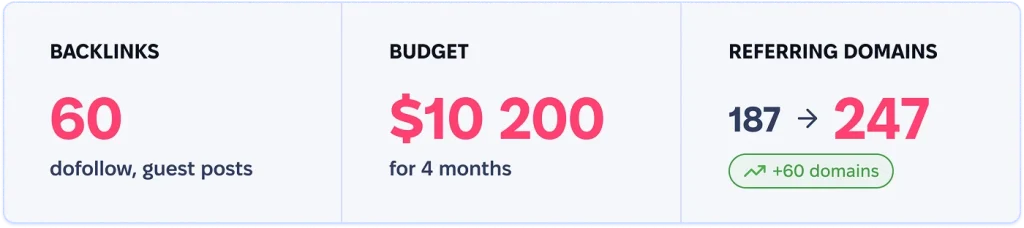
Over the course of our four-month partnership, we published 60 guest posts for the client on relevant websites and cleaned up the existing profile by removing toxic links.
About the Client and Their Challenges
Our client is a US based SaaS service in the project management niche for remote teams. The product has been on the market for about two years and has its own in-house SEO team: a content marketer, a technical SEO specialist, and an editor. The team lacks an outreach specialist, which is why they reached out to us. So, what was the client struggling with?
- The in-house team is overwhelmed with content and technical tasks, leaving no resources for manual outreach
- Competitors in USA search results are growing faster in terms of backlink volume and the number of guest posts
- Previous experience with a link exchange platform produced poor results
The client was very straightforward about the marketplace: there are webmasters on these platforms who drag things out for 30-60 days and constantly reject content. The client’s team also found that guarantees weren’t being honored, so this approach doesn’t scale well. The result? Eight links, half of which were spam, and a budget wasted on nothing.
Objectives and Starting Point
Before getting started, we conducted a backlink profile audit and a competitor analysis. Key metrics: Domain Rating: 24, referring domains: 187 (of which only 28 were from the USA with a DR of 50+). Guest posts in the profile: 11 over the entire history of the project.
Based on the competitor analysis and discussions with their in-house SEO team, we jointly developed a plan of tasks to be completed for this project as part of our link building strategy.
- Conduct an audit of the existing backlink profile and identify toxic links
- Perform a backlink gap analysis of competitors in the SaaS/project management niche in the USA
- Work with the client’s team to develop a keyword plan (a list of priority search queries and pages for link building)
- Identify 60 relevant donor sites (DR 40-50) in the USA
- Place links, monitor indexing, and prepare reports
How Did We Achieve These Goals?
The client came to us after a failed attempt with a link exchange service, where half of the 8 links turned out to be spam. The in-house SEO team didn’t have the resources to handle manual outreach. We took over the entire process (from researching competitors to placements). We carefully vetted every donor site and anchor text. With our help, the client’s backlink profile grew significantly.
Head of Outreach · NeedMyLink
The project was carried out in partnership with the client’s in-house SEO team. We handled all aspects of link building, from research to reporting; the client’s team approved the keyword plan, landing pages, and anchor text, while our team’s copywriters wrote the content. We used the Standard Pro package: $1,700 for 10 links (6 each), average DR 40-50, donor traffic 3-5k.
Would you like some too?
Check out the full list of domains where we've done backlink placements for the SaaS client from the USA!
View domains1. Audit of the Current Profile and Search for Spam Links
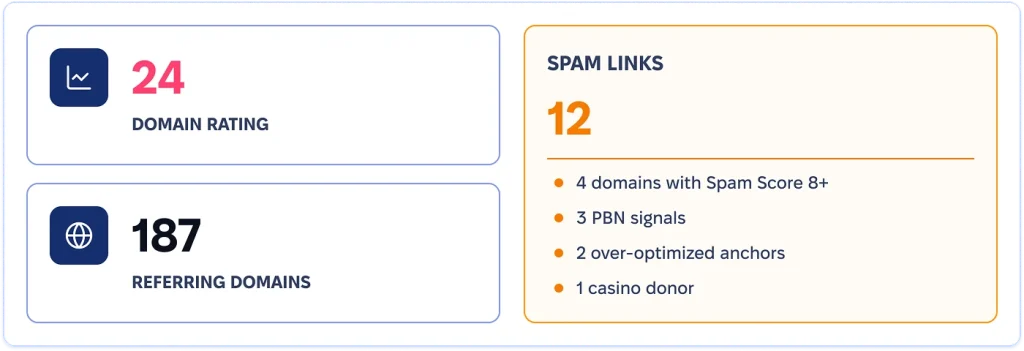
Where did we start? First, we ran the profile through Ahrefs and Moz, identified 12 spammy backlinks, and recommended that the client’s team submit them to Google’s Disavow Tool. How did we identify the spammy backlinks? We relied on the following key criteria:
- Moz Spam Score of 8 or higher when the donor site’s topic is irrelevant.
- PBN indicators: domains hosted on the same IP block, boilerplate footer, thin content (200-300 words per page).
- Over-optimized commercial anchor text containing the high-volume keyword.
This isn’t about automatically disavowing everything that seemed suspicious. For each link, we manually opened the source and checked the context. Of the 24 links flagged by Ahrefs’ automatic filter, only 12 made it onto the final disavow list after manual review.
2. Competitor Analysis and Backlink Gap
We identified the three closest competitors from the top 10 results in the USA for the client’s primary search query cluster. We ran them through the Ahrefs Backlink Gap Tool. We found 84 domains that link to all three competitors but do not link to the client. Of these, 63 were found to be relevant to the niche and available for outreach.
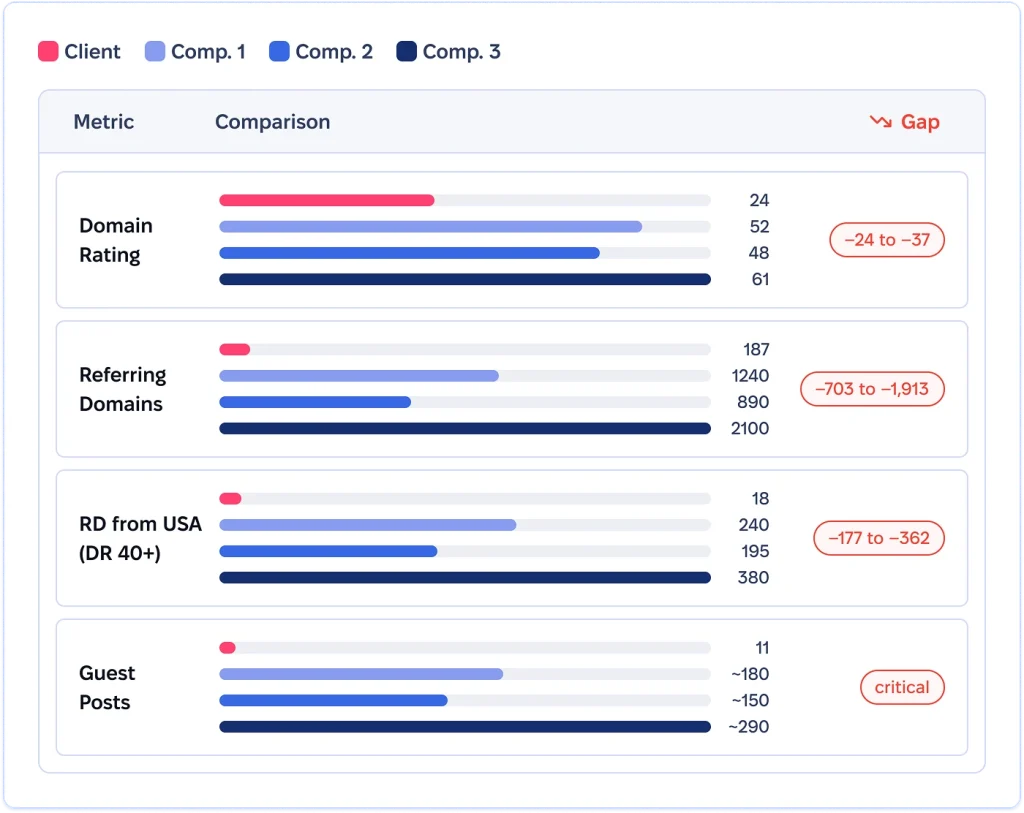
This analysis revealed the key point: the client is lagging behind not only in terms of the total number of links, but specifically in terms of guest posts on niche websites. Competitors have 150-290 such posts, while the client has 11.
3. Creating a Keyword Plan
Next, we worked with the client’s team to compile a list of priority search queries and pages to which we will link. Here are the main clusters:
- Brand and navigation keywords to the homepage.
- “Project management software for remote teams,” “remote team collaboration software” to /features.
- “Asana alternative,” “Trello alternative” to comparison landing pages.
For each keyword, we determined which type of anchor text would be most suitable: brand-based, diluted, or commercial with direct inclusion. This formed the basis of the anchor text plan.
4. Selection of Themed Domains
For SaaS companies in the USA, it’s not just disaster recovery that matters, but also the subject matter and actual traffic. We filtered based on the following criteria:
- Topics: productivity, remote work, business software, B2B SaaS
- At least 60% of total traffic comes from the U.S.
- Organic traffic in Ahrefs: 3,000 or more
- Moz Spam Score below 5
Out of 63 shortlisted donors, 56 made it to the final placement. Seven were eliminated: some saw a drop in traffic over the quarter, others had “sponsored” labels appear in their outreach correspondence, and two showed signs of PBN activity. The remaining 4 links were secured from the extended list for a total of 60 placements (as planned with the client’s team as part of our assistance).
5. Anchor Plan and Placement Schedule
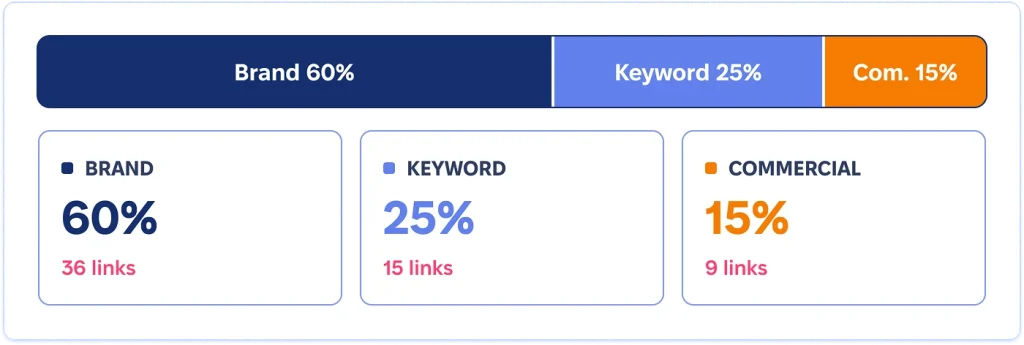
The backlinks were distributed in such a way that the profile looked natural. The posting rate was capped at 15 links per month. This is critical. If you post 60 links all at once over a two-week period, Google interprets this as an artificial spike. We spread the posts out over four months and distributed them on a weekly basis.
6. Content Writing
We wrote a separate 1,100-1,400 word article for each sponsor, tailored to their audience and editorial policy. First, we analyzed the sponsor’s top 10 articles on similar topics to understand what resonated with the audience and what should be excluded. Next, we drafted an outline and began writing SEO articles with examples and links to the product in a natural context. We checked the articles for uniqueness (1text), grammar (Grammarly), and AI detection (zerogpt).
7. Placement, Indexing, Reporting
After publication, each link was checked for the dofollow attribute, correct anchor text, and placement within the article body (rather than in the footer or sidebar). Next, the links were submitted for indexing via the Google Indexing API. According to our statistics, 100% of links are indexed within an average of 9 days.
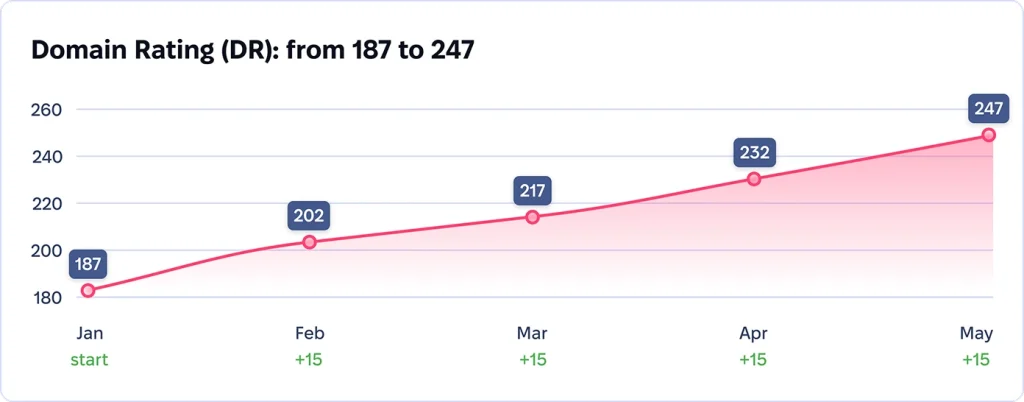
The client’s team received a report for each link: source URL, post URL, anchor text, placement screenshot, and Ahrefs metrics as of the publication date. In addition, a general dashboard for the link building plan was provided every two weeks.
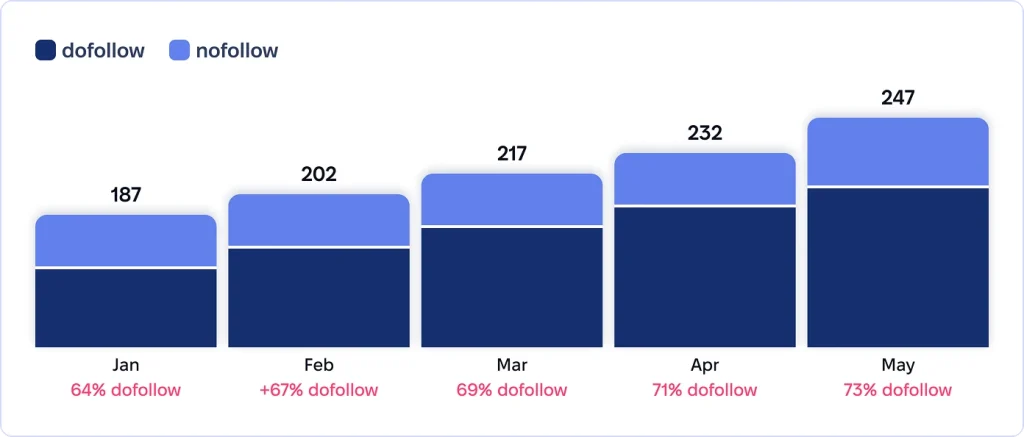
Another key point is that we were able to adjust the balance of the backlink profile in terms of nofollow and dofollow links. Before working with us, the dofollow rate was only 64 percent. After four months, we were able to increase that rate to 73%.
Conclusion
What does this case study demonstrate? What hypotheses does it confirm? For the SaaS niche in the USA, a partnership model involving the client’s internal team is effective. We handle all aspects of link building (from research to reporting) while the client’s team is responsible for strategy and product development.
The hypothesis confirmed by this case study: outreach with thematic domain filtering and a competent anchor text plan yields a stable, high-quality profile, unlike exchanges with fixed prices and a cookie-cutter approach. The challenges were standard: expensive commercial placements, strict editorial policies of donor blogs, and coordinating anchor text with the team. These are resolved through negotiation and high-quality content.
Yevhen Humeniuk, CEO of NeedMyLink