










Every company conducts competitor analysis, but often not on a regular basis. After all, it involves a lot of routine work, and the results become outdated faster than you can finish reading them. Here’s how a project manager at our company solved this problem, even though no one had assigned him this task!
Why Is Manual Competitive Analysis Difficult?
Making it a thorough process requires opening several dozen competitors’ websites, analyzing their offerings, prices, and range of services, noting what has changed since the last time, and compiling all this information into a single table. The full cycle takes several days of work, which is precisely why, in many teams, it becomes a one-time exercise before a strategy session rather than a regular process.
Next comes the choice every team must make: either conduct an in-depth analysis of a few of the most obvious competitors, or a superficial analysis of all of them. There are often not enough resources to do both at the same time.
How Did Andrii Automate This Task?
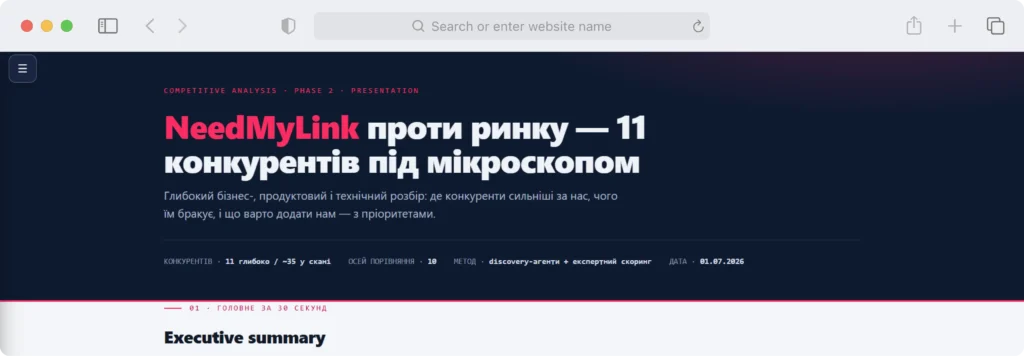
Our project manager, Andrii Pukhalskyi, created a separate project on Claude Code CLI for this task. What this project does:
- Conducts an in-depth analysis of 11 key competitors.
- Performs superficial monitoring of 35 competitors.
- Analyzes each of them across 10 areas, ranging from positioning and USPs to service offerings and pricing models.
- The company employs about 100 agents who work simultaneously in their respective areas.
Parallel processing solves the problem here, since a single large query covering 46 companies at once would inevitably lead to superficial generalizations. The depth of analysis decreases as the volume and number of criteria increase. By dividing the task among individual specialists in their respective fields, we were able to maintain both parameters.
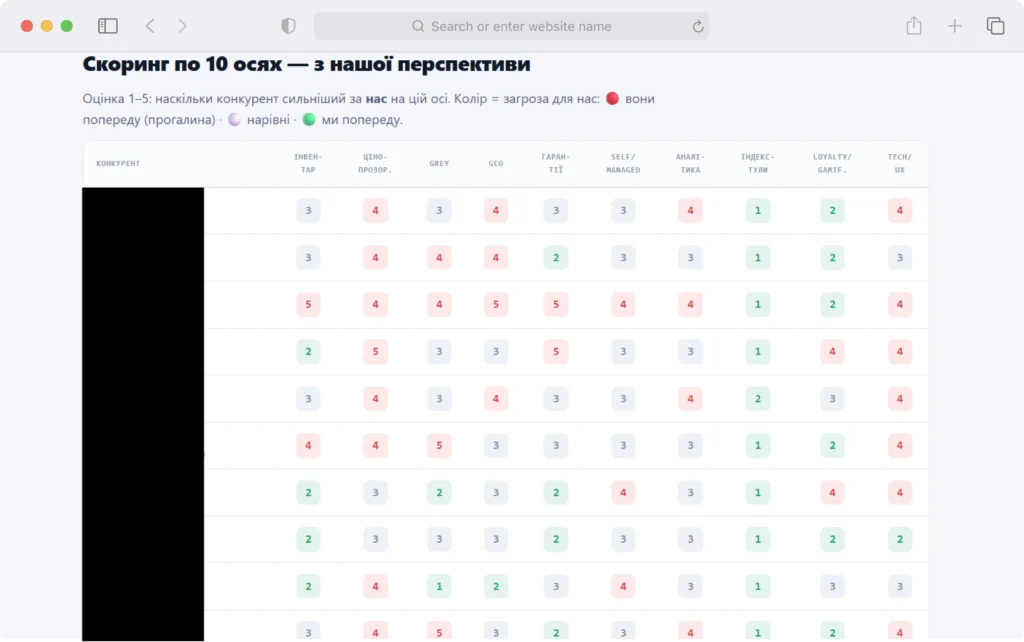
As a result, the team receives a report containing detailed analytical data on competitors’ positioning, USPs, offers, unique selling points, and new services. The report also includes a comparison with our own positioning and a list of growth areas, which is, in fact, the very reason this entire process was undertaken.
What Did That Change?
The manual work was divided into two parts, and the AI reduced the time required for each. Gathering sources cut the time spent by 10 hours per month. Analyzing the collected data which involves consolidating metrics and determining what is significant was reduced by another 5 hours. We estimate that performing a similar task manually with the same level of depth would have taken 60-70 hours.
Most importantly, the choice between “deep” and “broad” has disappeared: the scope of monitoring has increased tenfold, and we now track all 46 competitors instead of just a few of the most obvious ones.
What’s our advice? You shouldn’t automate the entire process at once, but rather the part that takes the most time and involves the fewest decisions. In competitive analysis, that’s the detailed data collection, not the conclusions. People still draw the conclusions, it’s just that now they do so based on complete data and with the help of AI.
Why Do We Consider Implementation More Important Than the Tool?
There was no specific task to “automate competitor analysis,” and no one had assigned it to Andrii. He tackled the problem head-on, devoted time to it, and developed a working solution using a tool he had to learn from scratch.
Andrii joined the team as a QA engineer, then became a project manager, and is now preparing to transition to a product owner role. This initiative was one of the factors that led to his promotion and the expansion of his responsibilities.
We’re growing and looking for employees. Current job openings: Djinni | DOU

Nik Zakharchenko, CBDO of NeedMyLink