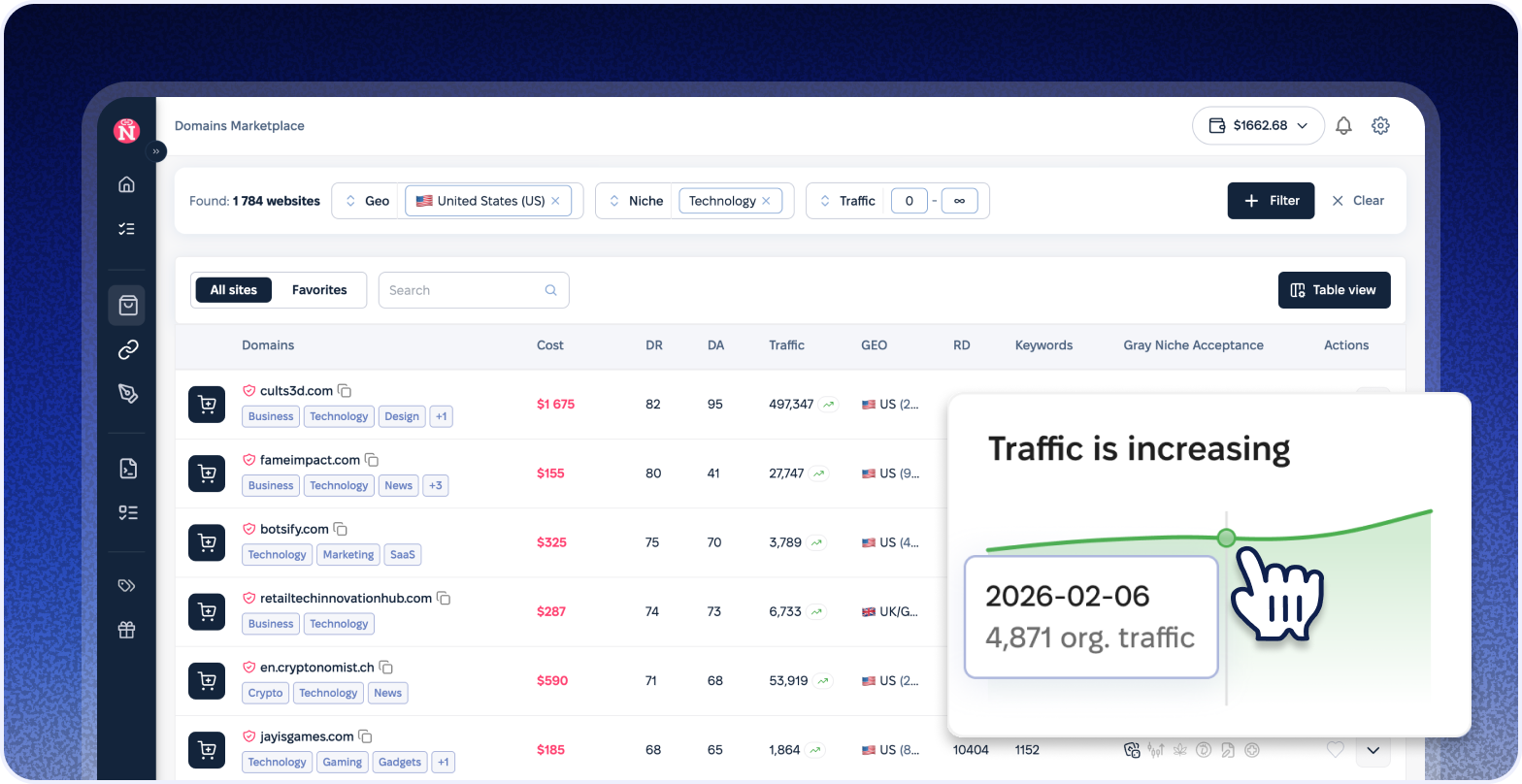











You can buy a batch of links in a single evening. Open a link marketplace, filter donors by DR, pay up, and you’re down fifteen hundred dollars with twenty fresh backlinks by the end of the week. But how do you know what those links actually did, and what to do next? Usually, it turns out nobody remembers which anchors have already been used, half the placements point to the homepage, and your most profitable categories have zero links. A link building plan closes exactly these gaps!
When Do You Need a Link Building Plan?
The simplest test for whether you need a plan: right now, without opening a single spreadsheet, try answering three questions:
- How many links do you buy per month?
- What percentage of your anchors are branded?
- How many new referring domains does your closest competitor have?
If you can’t answer even one of these, you’re buying links blind. That said, there are also situations where it’s worth holding off, not just on the plan, but on buying links at all. First: if your site has technical issues. If pages aren’t indexed, or half your internal links point to 404s, external links simply won’t work. In that case, you need an SEO audit first. Second: if the site is brand new and there’s nothing to promote yet. Then you should start with keyword research and a content plan, and come back to links once you actually have something worth building links to.
The Principles Behind Our Link Building Plan
At NeedMyLink, what’s included depends on the package, but the foundation is the same. We start by analyzing your link profile and your competitors’ backlinks: link types, donor topics, anchor distribution, growth dynamics.
Based on that data, we build an anchor list. It is the split of branded, exact-match, mixed, and naked-URL anchors for each page. Google’s spam policies specifically call out over-optimized commercial anchors, so balance matters more than volume here. In parallel, we identify acceptor pages (the priority pages that will receive the link equity) and select donors for them based on your niche and geo. All of this rolls up into a purchasing calendar that shows how many placements of each type go out every month.
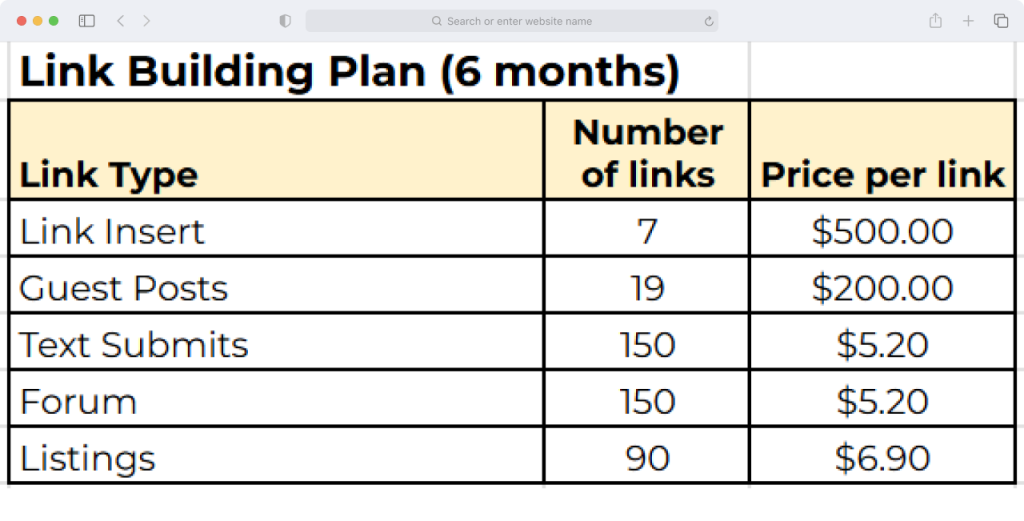
Here’s the link volume for a six-month plan for a US bulletin board: seven link inserts, nineteen guest posts, one hundred fifty contextual links, the same number of forum placements, plus ninety listings. The expensive formats work on commercial pages; the cheaper ones add volume and keep the profile looking natural.
How Do We Choose Which Pages Get the Links?
Pointing every link at the homepage seems logical. In theory, internal linking really does pass some of that weight to other pages on the site. In practice, so little of it reaches a page three levels deep that you won’t see any results.
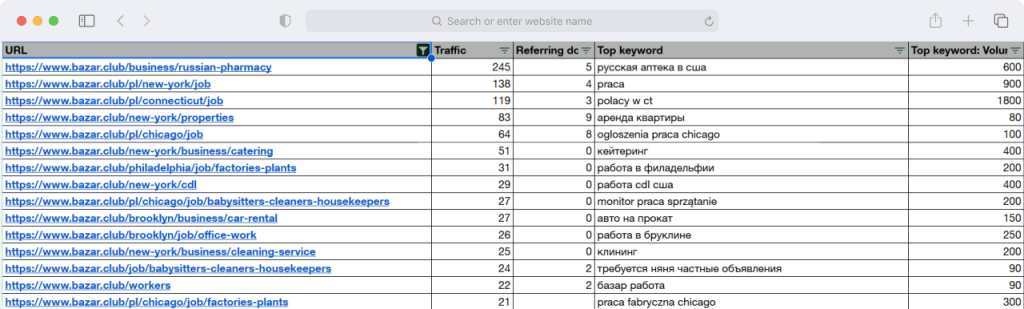
That’s why the plan always includes a dedicated acceptor-pages block. We pull every page along with its traffic, referring domain count, and rankings, then sort them by the gap between potential and current support. Put simply: a page already holding position one for its target query with five links doesn’t need twenty more. A page sitting on page two of the results with zero referring domains does.
Anchor Strategy and Profile Growth Pace
One of the most common mistakes is publishing every planned link at once. The idea seems sound: if the links are high quality, timing shouldn’t matter. In reality, this approach can backfire. A sharp spike in your profile followed by silence looks unnatural and doesn’t do you any favors on its own. It’s also important to be able to adjust placements as you go. Because once everything is published, you can no longer react to how the SERP responds.
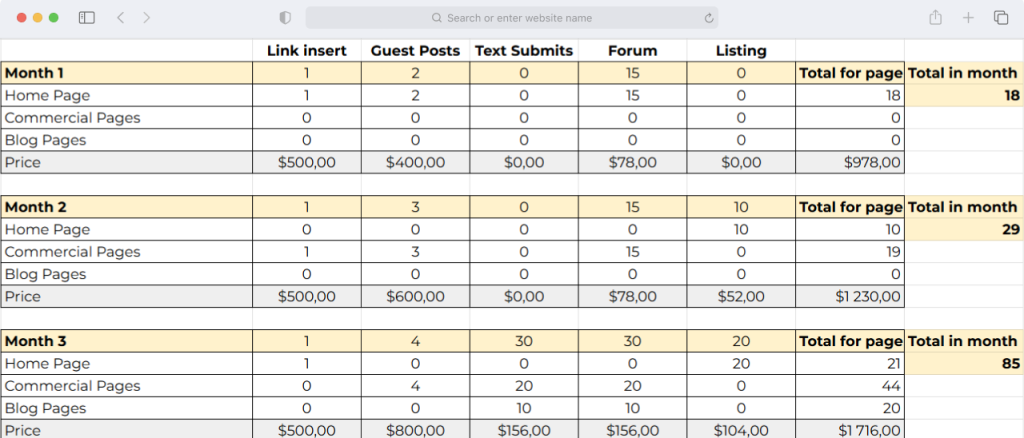
That’s why our plan is laid out month by month, with anchors reviewed before each stage. For example, in month three, we might see that a category has climbed and already has enough commercial anchors, so instead of adding five more of the same type, we switch to naked-URL and branded anchors. Or, the other way around, we reinforce a page that’s stuck.
Which Package Should You Choose?
Why does the plan cost as much as a month of actual placements? Simple: you’re paying for research hours, not a document. Breaking down up to five link profiles, pulling and cleaning the data, analyzing anchors, matching pages against intent, sourcing donors for your niche and geo – that’s all work we do ourselves.
- Test. Up to 10 pages, three competitors, and a three-month publishing schedule. It is usually chosen by clients who want to see the format of the document and how we work first, before moving into a longer-term partnership.
- Standard. Our working baseline for a commercial site. Up to 50 pages, five competitors, a six-month placement calendar, and, importantly, donor and acceptor selection already included.
- Premium. For larger projects with up to 200 pages. Includes a full year’s plan, placement indexing monitoring, and a disavow list. To be honest about disavow: it’s not something every site needs. In most cases, Google ignores low-quality links on its own and even recommends using this tool with caution. We add it only when a profile genuinely shows traces of links from sites that could trigger a search engine penalty.
- Advanced. For projects bigger than 200 pages, or ones that simply don’t fit a template (multiple regions, a grey-area niche, several domains at once, unconventional priorities). We’ll look at your structure, GEO, and goals, and put together a custom package built specifically for your project.
Regardless of the package, the document’s logic stays the same: analysis, anchors, acceptors, donors, calendar. What changes is the depth of research and the planning horizon. So even the Test package gets you a fully functional working plan, just for fewer pages and a shorter period.
What Happens After the Plan?
Our plan is a strategy, not the placements themselves. You can take the document and execute it on your own. You’ll have the donor lists, anchors, and page targets in hand. You can easily handle some of it yourself, or through our backlink marketplace, at whatever pace works for you. Or you can hand execution over to our team. In that case, we move into outreach and handle guest posts, forum and article placements as part of managed link building, while you get a monthly report and an updated anchor list. You don’t need to worry about content either – our writers handle SEO copywriting.
Links typically get indexed within a month, and a noticeable effect from link building can show up anywhere from 3 to 12 months out, depending on niche and competition. All placement risk stays on our side throughout: if a link disappears, we restore it, replace it, or refund you.

Nik Zakharchenko