










A list of blog topics can be put together in a single evening: open competitors’ websites, draft a dozen headlines, and distribute them across several months. At first glance, it already looks like a plan. The problems appear later. It turns out that half of the topics have no search demand, while two articles compete for the same query. In the end, the content writer still comes back with questions because a headline is all they have.
A NeedMyLink content plan works differently. Before a single topic is proposed, the team conducts keyword research for the project’s niche, groups the keywords, and only then turns them into specific content briefs.
When Is a Content Plan Really Necessary?
Clients most often contact us when they have been publishing content for some time but cannot see any results, while the website owner does not understand where to allocate the next portion of the budget. Another category includes projects with no content at all: the website has been launched, the catalog or service pages are ready, but there is no blog or informational section. In both cases, the underlying issue is the same: topics were selected without relying on actual search queries, making the results difficult to predict in advance.
Some projects order a content plan not because previous efforts failed, but because the business is scaling. A company enters a new market, adds another language or region, and the team realizes that the existing website structure cannot simply be replicated. Search queries are phrased differently, the competitive landscape changes, and users search for the same solution in a different way. In this case, a content plan is needed not to correct previous mistakes, but to avoid repeating them from scratch in a new market. Clients most often request a content plan in the following situations:
- The website is growing without a clear structure. Articles are being published, but each one exists on its own. There is no connection between topics and no understanding of which page should lead users toward a purchase and which one should simply satisfy an informational query.
- The website is not generating traffic. Content is published regularly, but the number of website visitors does not increase because topics are chosen based on assumptions rather than actual search demand. The issue may also be related to Google indexing, which is another area clients ask us to address.
- It is a new project. There is no keyword strategy or clear section structure, so every article is effectively created at random.
- The business is expanding. An approach that works well in one market often fails to deliver the same results in another because search queries, competition, and user intent are different.
There is another possible situation. If the keyword research has already been completed, the website structure is clear, and only the content itself is missing, a content plan will provide little additional value. In this case, it makes more sense to move directly to SEO copywriting.
Why Is a Topic List Not a Content Plan?
A list of topics answers the question “What should we write about?” and that is where its usefulness ends. It does not show how many people search for the topic each month, which websites the page will have to compete against, or which headline, structure, and URL will give it a realistic chance of reaching the top search results.
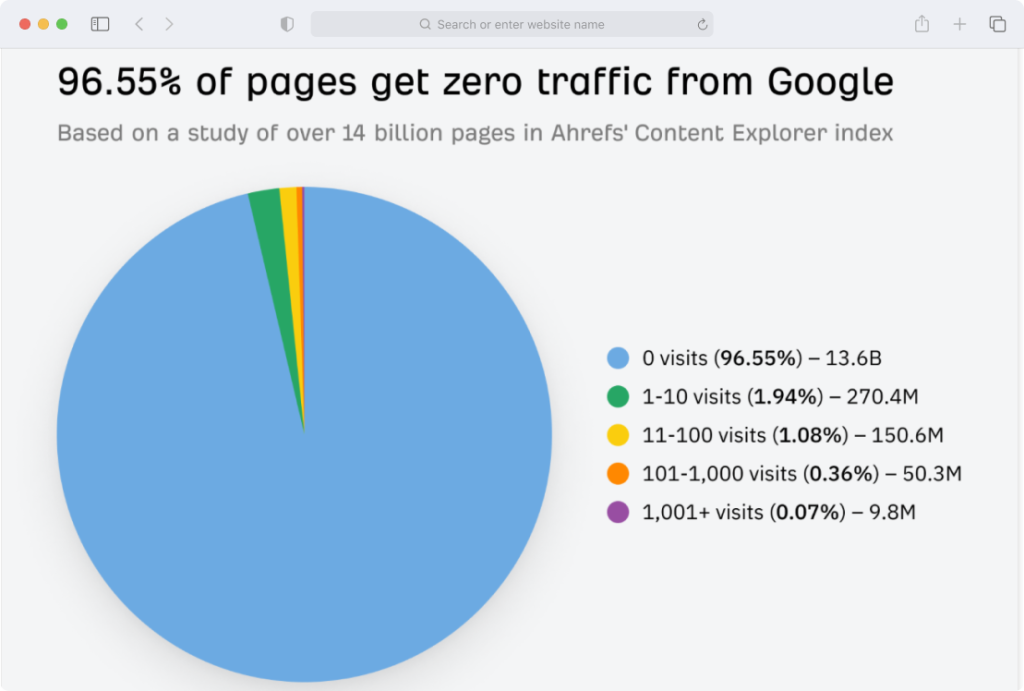
According to an Ahrefs study, 96.55% of pages on the internet receive no organic traffic from Google at all, and a considerable share of those pages cover topics that nobody is searching for.
NeedMyLink specialists research every topic in the content plan in detail. First, we evaluate search demand and keyword volume. We then identify the intent (informational, commercial, or navigational). Only after that is the topic turned into a brief containing a heading structure, target keywords, and recommendations for the writer. The content writer receives a document they can start working with immediately, without additional research or follow-up questions for the manager.
How We Create Our Content Plan
The process begins with an analysis of the niche and the website’s current structure, rather than a list of ideas. Our team conducts keyword research, groups keywords by topic, and then determines where a new article is required and where updating an existing page would be more effective. Sometimes an older page is closer to the top search results than it appears, and only needs a more precise heading or an additional content section.
Each keyword group is turned into a brief containing a title and meta description, an H-tag structure, primary and secondary keywords, a recommended URL slug, and concise guidance on what the writer should emphasize. The scope of this part depends on the selected package, ranging from ten briefs in the trial package to one hundred in the premium package. However, the keyword research and keyword grouping process remains the same for every client.
Why Are Priorities Important?
When a content plan includes thirty or one hundred briefs, it may be difficult to determine which ones should be handled first. A priority marker in the content plan indicates which topic is likely to deliver results faster because it has higher demand, lower competition, or a more direct connection to sales.
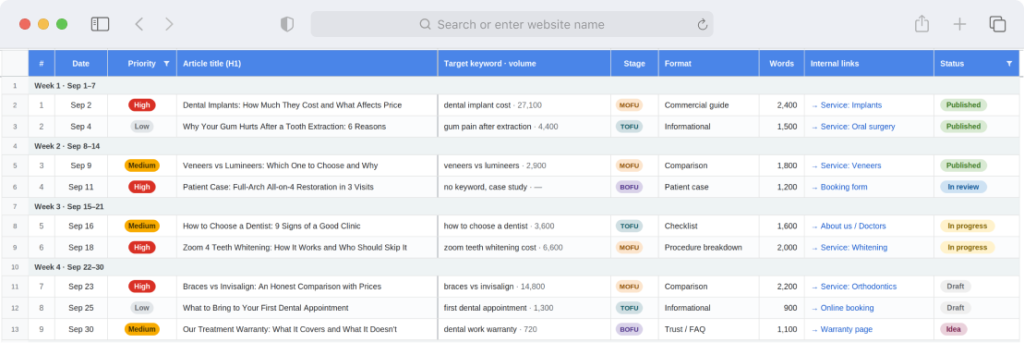
Topics with genuine search demand and relatively low competition for top-ranking positions come first. Topics that strengthen existing pages or fill gaps within a keyword group follow them. Reference and brand-building materials come last, as the website can continue operating without their immediate publication.
What Does the Client Receive?
A completed content plan consists of three components that work together. The foundation of the plan is grouped keyword research. We collect relevant queries, check their search volume, and organize them by topic. One page is planned for each keyword group. This prevents articles from competing against one another for the same ranking positions.
The keyword research is accompanied by detailed content briefs, with one brief for every topic in the plan. Each brief includes an H-heading structure, primary and secondary keywords to be incorporated into the content, an estimated word count, and concise guidance on what must be covered and what may be omitted. The client also receives ready-to-use publication recommendations, including a meta title, meta description, and URL slug. This means the page can be published as soon as the content is ready, without requiring additional approval from an SEO specialist.
The third component is a prioritized list of topics showing what should be written first and what can wait. Together, these three elements cover the entire preparation stage. The client or their content writer opens the relevant brief and starts writing instead of spending time on research that someone else should have completed before production began.
How Do the Packages Differ?
There are four packages because a content plan for a ten-page landing page and a plan for a two-hundred-page catalog involve very different numbers of queries, keyword groups, and content briefs. These scopes cannot realistically be completed within the same timeframe or for the same price.
The choice of package, therefore, depends not on its name or marketing label, but on the project’s current stage and the number of pages that genuinely need to be covered by the keyword strategy. A custom package is priced individually after the project has been assessed, so the final price and delivery timeline are confirmed separately.
What Happens After the Content Plan Is Completed?
A completed plan can be implemented in three ways: the client’s internal team can write the content, the work can be outsourced to another contractor, or the client can continue working with NeedMyLink, which also provides SEO copywriting. In the last case, the briefs move directly into content production without a gap between planning and publication. Clients interested specifically in the content plan and available packages can also use the same page to send their first question to the team.

Yevhen Humeniuk, CEO of NeedMyLink