


Scholarships are great for students, but can they be even better for SEOs? Once upon a time, all you needed was a decent scholarship and a bit of charm to get all the .edu backlinks. But as with most SEO hacks from 2015, now everything comes with a manual and a disclaimer.
Link building remains a cornerstone of effective SEO strategies. However, the efficiency of its methods changes fast. In 2015, Neil Patel described scholarship link building as one of the unusual and prominent tactics, earning an average of 47 links per scholarship and delivering up to a 10% ROI. Fast forward to 2025, and he puts it on the list of misconceptions about SEO and states that scholarship link building is no better than any other tactic. Surveys from different agencies agree that even on good days, you’re looking at fewer than 30 links and about a 6% return. Still decent, but does it justify the effort you must put into it?
What happened? And more importantly, is it still worth chasing .edu links through scholarship campaigns in 2025? Or should we let this strategy go and move on to the next big thing? In this article, we’ll break down the scholarship link building strategy: its advantages, challenges, current relevance, and how to execute it successfully.
🎓What Is Scholarship Link Building?
Scholarship link building is an SEO tactic where a business creates a scholarship (yes, a real one) and reaches out to colleges and universities to have it listed on their financial aid or external resources pages.
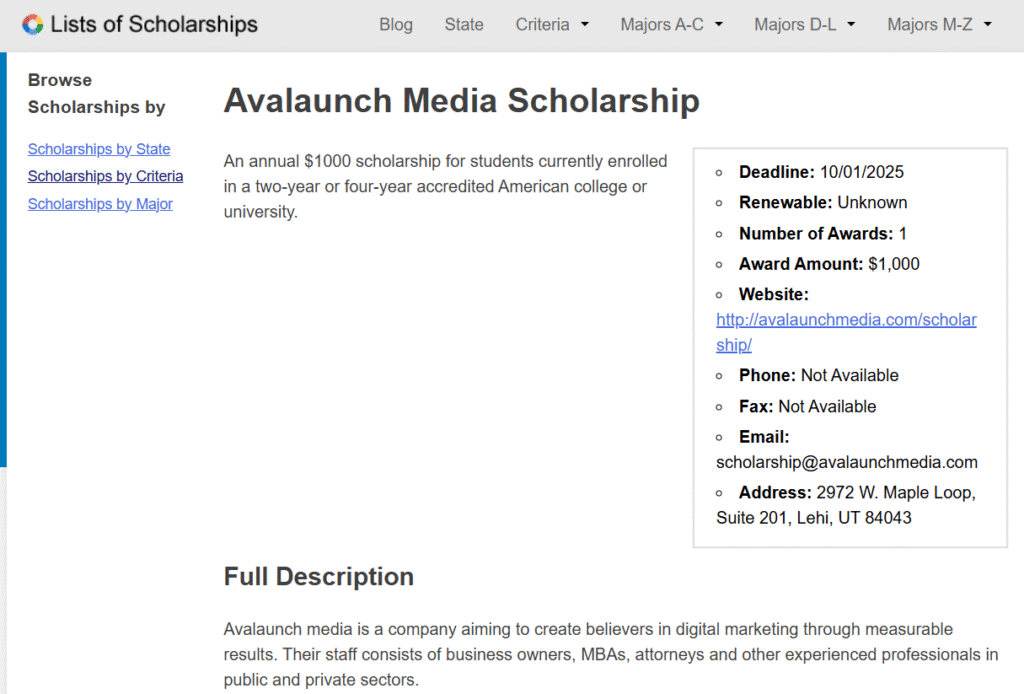
Why go through the trouble? Because .edu domains have strong domain authority, Google tends to trust them more than an average blog, no matter how prevalent they are. So, if your scholarship gets featured on a university site, you’re not just doing a good deed, you’re also earning high-quality backlinks that can seriously boost your search rankings and overall credibility.
📚The Evolution of Scholarship Link Building. What Does Google Think About It?
In the mid-2010s, scholarship links were seen by Google as ultra-valuable; most scholarship campaigns were relatively simple to execute and saw high success rates.
But as with any good SEO strategy, as it grew more popular, it has brought the attention of all sorts of shady businesses. There were a lot of fake scholarships and misuse of guest posts. So, Google said, “With great power comes great responsibility,” and put the brakes on scholarship links.
Scholarship link building is no different than anything else about Google and SEO. It’s not about what you’re doing, it’s how and why you’re doing it. If your scholarship is legit, actually helps students, and isn’t just a sneaky way to get backlinks, you’re probably in the clear.
However, if your backlink profile starts to look like a scholarship directory, Google could flag your website as a link scheme. Best case? Those links just get ignored. Worst case? It opens an investigation. Next thing you know, you’re looking at a penalty.
So, don’t try to fool the system; it never works in the long run. In 2025, scholarship link building has shifted from a quick win to a more long-term and reputation-focused approach.
🔗Is It Worth Building Scholarship Links for Your Brand?
In the right context, scholarship link building can absolutely pull its weight. The trick is knowing when it makes sense for your brand and goals. So, here are 4 factors to consider before launching a scholarship campaign:
- You can offer real financial support.
We’re talking about actual help here, not a $50 gift card from grandma on Christmas. Most educational institutions won’t list anything under $500, and many prefer $1,000 or more. If you’re not ready to invest in supporting students, this probably isn’t the strategy for you. - Your brand values education, community, and social impact.
If anything mentioned above is part of your brand’s values, the scholarship program could become a genuine extension of your business, not just another PR stunt. - You have the time and capacity to manage the process.
Running a scholarship program isn’t something you’ve done once and forgotten about. You’ll need someone to build the website and campaign, do the outreach, respond to questions, and eventually select winners. If that sounds overwhelming and costly, this might not be your ideal link building route. - You’re playing the long game.
Scholarship links don’t bring traffic overnight. But if your goal is to build long-term authority, increase trust, and slowly climb the rankings with high-quality backlinks, it’s a solid addition to your strategy.
Did you tick all the boxes? If so, congratulations! You’re ready to start a scholarship link building journey. But if you’re only in it for the links, there are faster and easier ways to improve your ranking (more on this at NeedMyLink blog).


🚫Are Scholarship Links Still Effective, or Are They a Dead Strategy?
As of 2025, scholarship link building isn’t dead. But let’s be honest, it’s not as easy as it used to be.
Google’s algorithms have gotten smarter, and now care way more about why and how you’re building links. Low-effort or manipulative campaigns? They’re not just ineffective, they’re risky.
But here’s the good news: with some effort, scholarship link building still works. You need a scholarship that makes sense for your brand, offers something meaningful to applicants, and feels like a genuine contribution. A thoughtful, well-executed campaign can earn you high-authority backlinks, a stronger brand reputation, and even organic traffic over time.
So no, scholarship link building isn’t dead. But it has evolved from a quick SEO hack into a long-term, strategic PR move. It takes more time, thought, and resources. The payoff? Still here, just not immediate. If you’re in it for the long run, creating a scholarship program will be well worth the investment.
✅Pros & Cons of Using Scholarships for Links
Like any SEO tactic, scholarship link building comes with its pros and cons. So, let’s sum up everything from the previous sections.
✅The Potential of Scholarship Link Building
- Getting listed on .edu domains can seriously boost your site’s credibility. Those are some of the strongest, most trusted backlinks you can earn.
- Supporting students and education makes your brand look good. It’s a smart way to build trust with both users and search engines.
- While it’s not an instant traffic driver, scholarship links can steadily improve your domain authority and search rankings over time.
- A unique or meaningful scholarship can attract local news coverage, blogger mentions, and social media buzz, especially if it ties into current issues and helps people who need it the most.
- Reaching out to universities, foundations, and education blogs can open doors to new partnerships you wouldn’t think of on your own.
❌The Downside of Scholarship Link Building
- You need to have A LOT of resources to spare. Between crafting the offer, building a landing page, doing outreach, managing applications, and selecting winners, it’s a lot to keep in mind.
- You won’t see results overnight. This is a big investment in your future.
- Some institutions have strict linking policies or simply won’t list your scholarship, no matter how genuine it is. Expect a fair number of ghosting and rejection. It’s part of the game.
- Scholarship link building campaign might feel templated or overly promotional. In this case, your risk of being ignored by schools or getting penalties from Google is much higher.
- This isn’t the place, nor the time for any shady schemes. Except for penalties from search engines, you’re risking your reputation and credibility. That’s a PR mess that even Tree Paine won’t be able to fix.
🛠️The Process of Building Scholarship Links
If you’ve read this far, you probably decided that scholarship link building is the strategy for you. And you started to wonder, “Where should I begin?” The answer is here. Literally!
There is a step-by-step breakdown of the scholarship link building process:
1️⃣ Develop a Clear Scholarship Plan
A well-thought-out scholarship plan is the heart of your campaign. It’s the part everyone will take the most seriously. So, before you even start thinking about backlinks, there are 12 things to consider:
| # | Required Information | Explanation |
| 1 | Scholarship Goal | Why are you creating the scholarship? (social responsibility, supporting education, PR, SEO). |
| 2 | Target Audience | Who can apply: students, prospective students, master’s students, specific specialties, or universities? |
| 3 | Scholarship Amount | What amount are you willing to provide? (e.g., $500, $1000)? |
| 4 | Application Deadline | What is the deadline for submitting applications? |
| 5 | Participation Requirements | What are the eligibility requirements for candidates? GPA, essay, video, portfolio, etc. |
| 6 | Application Format | How do you apply: form on the website, email, or Google Forms? |
| 7 | Selection Process | Who will select the winner, and how? Will there be a jury? What are the criteria? |
| 8 | Promotion Plan | How will you spread the information about the scholarship? (email, outreach, social media). |
| 9 | URL Address of the Page | Clear structure and URL of the future scholarship page. |
| 10 | Legal Aspects | Participation rules, permission to use data, and agreement with terms and conditions. |
| 11 | Branding | Will the company logo, visual style, etc., be used? |
| 12 | Contact Person | Email or name of the manager to contact for questions. |
2️⃣ Forecast the Outcome of Your Scholarship Strategy
Before diving in too deep, it’s smart to estimate the potential payoff of your scholarship campaign. Set realistic expectations and track the progress. Here are a few things to keep in mind:
- How many high-authority .edu links do you expect to secure?
- What kind of traffic boost are you aiming to get from these backlinks?
- Will your scholarship spark news coverage or buzz on social media?
- Is the potential ROI, improved rankings, and traffic worth it?
Good thing you don’t need a medium or a tarot reading for this. To get a clearer picture, you can use tools like Ahrefs or Moz. These platforms can help project the potential you might see from your scholarship links, giving you a better sense of whether the campaign will be a good investment.
While forecasting isn’t an exact science, having some numbers to aim for will make your efforts feel much more strategic.
3️⃣ Get Your Scholarship Page Online
Great, you’ve got through all the planning and forecasting! Time to make it official. Your scholarship needs a dedicated page on your website that’s clear, detailed, and easy to navigate. Please, don’t bury it in the depths of the “Other” page. And as a bare minimum, include:
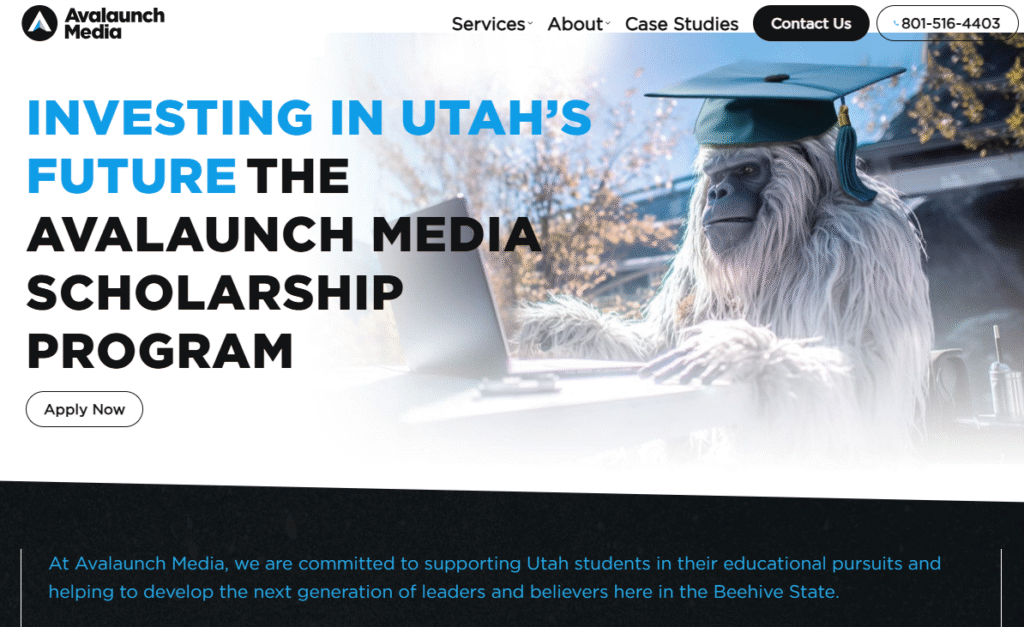
- Scholarship name and a short description
- Eligibility requirements
- Award amount and important deadlines
- Application process and how to apply
- Contact info in case someone has questions
Bonus points if you add extras like judging criteria, FAQs, or, with time, highlights of past winners. This helps build trust and show that you’re serious.
Keep the tone professional and transparent. Save the sales pitch for another page. Scholarship is an opportunity for you and anyone interested. So, make sure it’s easy to find, mobile-friendly, and accessible to users of all backgrounds.
4️⃣ Start Your Scholarship Outreach Campaign
Now comes the “getting your scholarship in front of the right people” part. Start building an outreach list, including:
- College and university financial aid offices (especially those that link to external opportunities)
- Reputable scholarship databases
- Education-focused blogs, forums, and newsletters
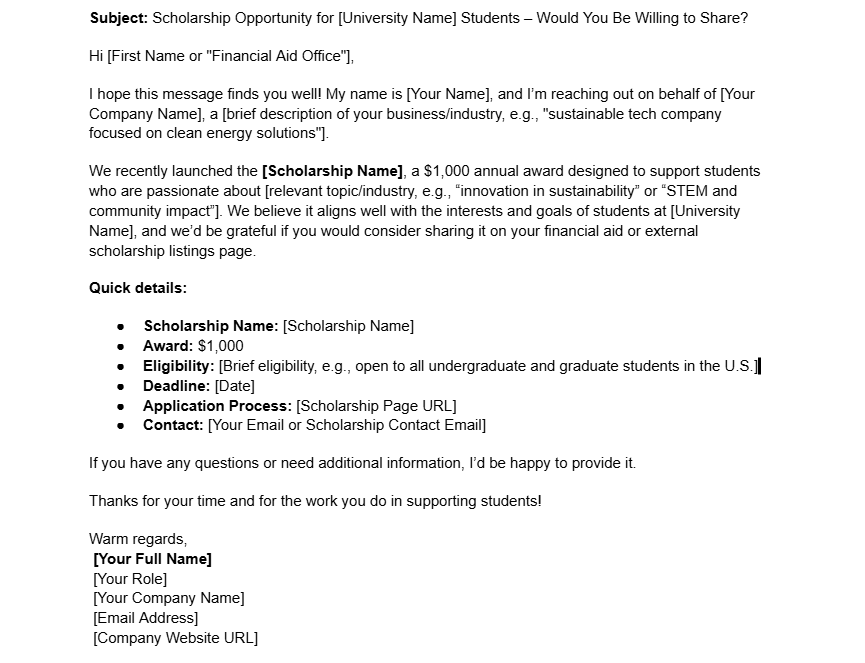
Once your list is ready, craft a respectful, personalized email for each contact. Keep it short and clear: introduce your scholarship, explain who it helps and why it’s meaningful, and politely ask if they’d consider listing it on their site or sharing it with students. Make their job easy by including all the relevant info and a direct link to your scholarship page. Here is an example of an email with all the details you should mention in it:
One more thing: some people take weeks to respond. Some never do. That’s okay. Write a follow-up email: a gentle reminder, a week or two later, can make all the difference. This is a great relationship-building method. And keep track of who you’ve contacted, Google Sheets will become your best friend in those weeks.
Pro tip: Don’t keep your scholarship a secret. Share it on social media, send out press releases, and get involved in niche forums or communities that align with your scholarship’s theme.
5️⃣ Analyze Results and Improve Your Approach
Unfortunately, once your scholarship campaign is live, you don’t have time to sit back and relax. Keep an eye on key metrics like:
- Number of backlinks and domain authority (focus on quality over quantity)
- Growth in organic traffic. Are those links helping your rankings climb?
- Referral traffic from .edu domains. Are people clicking through and exploring your site?
- Scholarship application numbers and engagement. Are students actually applying? Are they sharing it?
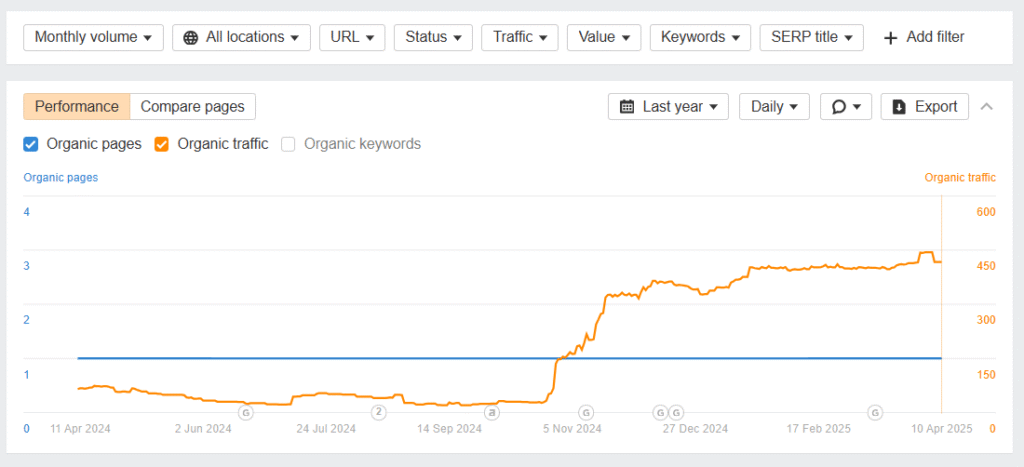
You can use Ahrefs to collect the data. This information will help you figure out what worked, what flopped, and what to tweak next time. Maybe your outreach emails need more personalization? Maybe your scholarship could be more niche? Or maybe your landing page just needs a clearer call to action?
Treat it like any other marketing campaign: test, learn, and improve. Scholarship link building is a long game, and you should get better at it with each round.
As we’ve seen, scholarship link building in 2025 is far from dead, but the days of quick wins and easy .edu backlinks are behind. However, it can still be an effective tool for SEO and brand growth. The success of this strategy today demands more than just creating a scholarship and hoping for the best. It’s about building genuine value, nurturing relationships, and being patient as you work toward long-term benefits.
To maximize your results:
- Tailor the scholarship to your industry and audience.
- Build genuine relationships with universities, blogs, and students.
- Don’t spam, quality beats quantity.
- Document everything, use Google Sheets to track responses, deadlines, and links.
- Share your scholarship wherever you can: on social media, write press releases, and post on niche forums.
If done thoughtfully, scholarship link building can enhance your brand’s credibility, foster community goodwill, and gradually boost your search rankings. But it’s no longer a shortcut. So, if you’re up for the challenge, the payoff can be substantial! And if there are any questions left, you can always count on NeedMyLink experts to help you find the perfect link-building method aligned with your business goals.


